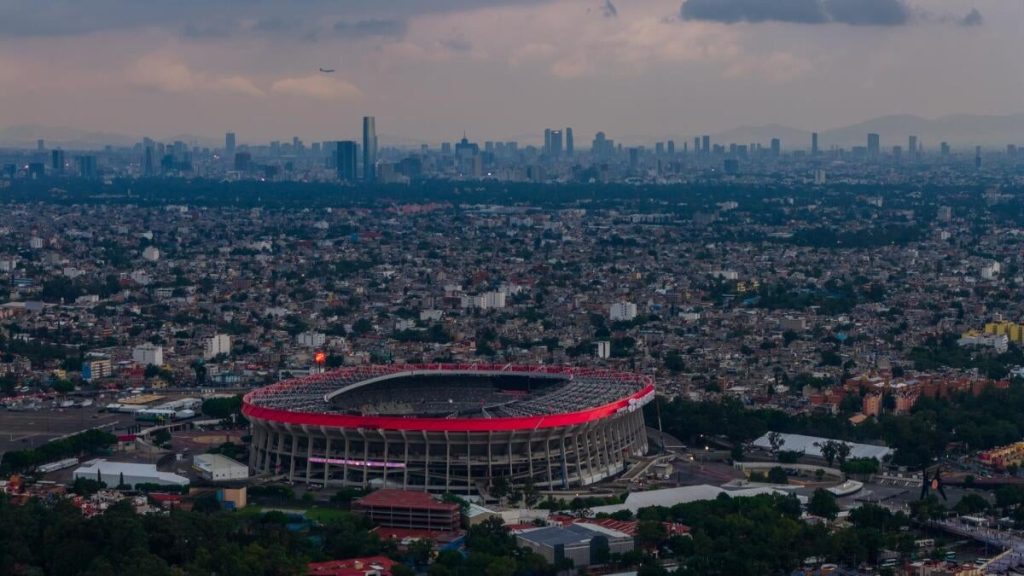
Unconquerable Fortress: Estadio Azteca’s Unyielding History
The 2026 FIFA World Cup has witnessed numerous thrilling moments, from debutant teams making a mark to legendary icons producing incredible stats. One topic that has garnered significant attention is the Estadio Azteca, the unofficial cathedral of the World Cup.
With a rich history spanning sixty years, Estadio Azteca has been the backdrop to numerous monumental moments in both the World Cup and Mexican soccer history. A type of unconquerable fortress that only the most legendary teams have managed to conquer, carving their names inside its concrete memories.
One such iconic moment was when Pele conquered the Azteca in 1970, winning his third World Cup title amidst a sea of fans cheering on Brazil and the history they made. In 1986, Maradona baptized himself in controversy against England with the infamous ‘Hand of God,’ and later immortalized his legacy inside the stadium when he lifted the trophy that year.
The Altitude Advantage
The Estadio Azteca’s unique feature is its high altitude, sitting roughly 7,220 feet (2,240 meters) above sea level. The thinner air reduces oxygen levels for players, while allowing the ball to travel faster and farther than in sea-level stadiums.
This drastic shift in environmental conditions can be overwhelming for teams not accustomed to the settings. Players may experience fatigue levels quicker, affecting them physiologically, and with the ball moving differently than what they are accustomed to outside of Mexico.
Teams that press early and often may end up paying the price in endurance, and ball movement can sometimes throw teams off when they’re looking for quicker movements, and the trajectory is not what they anticipated.
England’s Challenge
England’s head coach, Thomas Tuchel, acknowledged the challenges his team will face at the Estadio Azteca, stating, ‘It is maybe one of the most beautiful fixtures, most exciting fixtures than you can have play against Mexico in the Azteca, and there will be a lot, a lot, a lot of obstacles waiting for us, not to mention, like, the altitude will be, of course, a big disadvantage, because we cannot physically adapt to it in four days, it’s just impossible.’
Tuchel’s team will have to navigate the altitude, as well as the noise and celebrations generated by the crowd. The added noise can be measured physically, and has been. During the broadcast of Mexico’s knockout game against Ecuador, cameras were shaken due to the deliriously happy and celebratory crowd.
The system, SASSLA, noted ‘a significant artificial signal’ recorded by a professional-grade seismograph near the Azteca. The system sent a notification on its social platforms saying ‘the outburst of euphoria and mass shouting produced vibrations’ in the area.
The Unforgiving Stage
The Estadio Azteca’s crowd atmosphere and altitude make it a unique and unforgiving stage for teams. While acclimatization helps, it can never fully solve the equation of environmental changes multiplied by 87,000 fanatics.
Mexico’s head coach, Javier Aguirre, has described the crowd atmosphere at the Azteca as the team’s ’12th man.’ The altitude, with its invisible, relentless efforts, functions like a 13th player.
The added noise generated by the crowd can be overwhelming, even for teams accustomed to playing in altitude. Outside of players, officials have noted almost echo-chamber-like conditions, and it is something coaches cannot truly prepare for but can only anticipate.
The Fortress of Estadio Azteca
The Estadio Azteca has been a fortress for Mexico, with the team embracing the unique conditions of the stadium. While getting acclimated or familiarizing oneself with altitude can help some teams, in 2026, that has yet to prove itself through wins.
Mexico has won their tournament opener at Azteca against South Africa, then went away to win in Monterrey against South Korea, and Czechia in Guadalajara, before returning to Mexico City for their knockout path.
The 2026 roster, which won outside Azteca, is notable since in past World Cups the team has bowed out of previous tournaments away from Mexico City.
A blowout, 4-1, quarterfinal defeat to Italy in 1970 at the Estadio Luis Dosal in Toluca, followed by a painful 1986 quarterfinal penalty shootout loss to West Germany at the Estadio Universitario in Monterrey, are the two biggest examples of Azteca’s unforgiving nature.