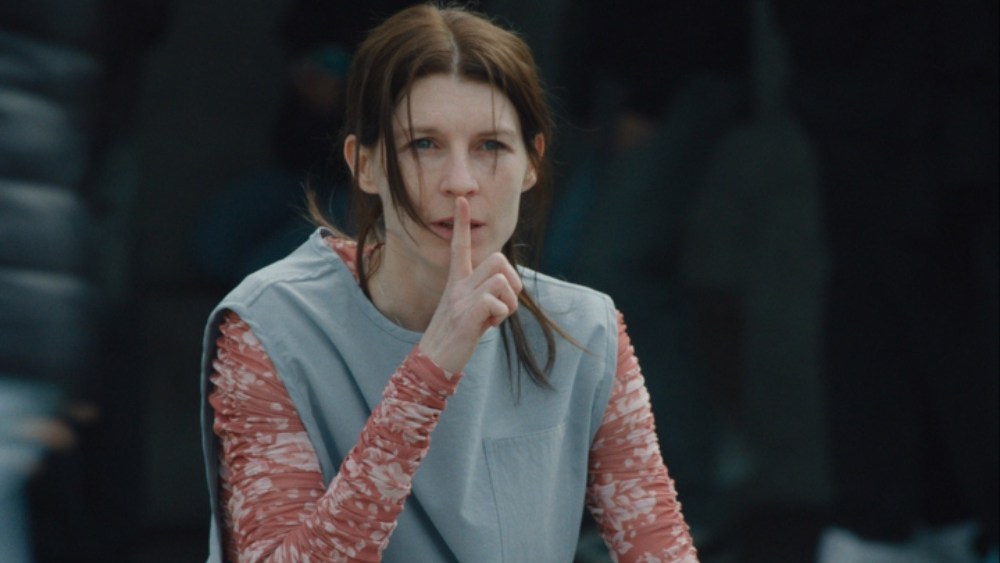
Swiss director Jan-Eric Mack’s Karlovy Vary competition entry, ‘A Happy Family’, is a custody drama that promises much but delivers less. Beneath its surface-level narrative, however, lies a more complex and intriguing story waiting to be explored. The film follows Nicole ‘Niki’ Hofer, a single mother of two, played by the talented Anna Schinz, as she navigates the challenges of working multiple jobs and raising her children amidst the scrutiny of child protection services.
From the outset, it’s clear that Niki loves her children dearly, but her struggles to make ends meet and provide for their well-being are palpable. The film’s opening scene sets the tone for the rest of the story, showcasing Niki’s resourcefulness and determination in the face of adversity. However, as the narrative unfolds, it becomes increasingly apparent that Niki’s impulsive behavior and lack of foresight are significant factors contributing to her situation.
The cinematography by Yunus Roy Imer is noteworthy, capturing the naturalism and attention to mood shifts reminiscent of his work on Nora Fingscheidt’s ‘System Crasher’. The aesthetic is effective in conveying the emotional intensity of Niki’s interactions with her children and the case workers. Nevertheless, the film’s reliance on this visual style raises questions about its purpose and the themes it aims to explore.
Anna Schinz delivers a powerful performance as Niki, bringing depth and nuance to a character that could have easily been reduced to a one-dimensional caricature. Her portrayal of Niki’s complexities, flaws, and vulnerabilities is captivating, making it easy to empathize with her character’s plight. The supporting cast, including Michael Neuenschwander, Julia Jentsch, and Alireza Bayram, adds depth to the narrative, but ultimately, the film’s focus on Niki’s story overshadows their contributions.
Despite its intriguing premise, ‘A Happy Family’ ultimately falls short of its full potential. The film’s refusal to engage with the idea that Niki’s reckless behavior is, in part, responsible for her situation is a missed opportunity. By romanticizing her impulsivity and excusing her lack of foresight, the film reduces Niki’s complexities to a simplistic, heart-of-gold trope. In contrast, Daisy-May Hudson’s ‘Lollipop’ offers a more nuanced exploration of a complex female protagonist, situating her story within a wider socioeconomic context.
Jan-Eric Mack’s direction is uneven, veering wildly between melodrama and a more promising, daring narrative. The film’s tone is jarring, particularly in its handling of Niki’s immaturity and lack of self-awareness. While these moments are dramatically compelling, they ultimately undermine the film’s credibility and its attempts to explore more profound themes.
In conclusion, ‘A Happy Family’ is a custody drama that promises much but delivers less. Despite Anna Schinz’s powerful performance, the film’s refusal to engage with its protagonist’s complexities and its reliance on a simplistic, heart-of-gold trope ultimately render it a confused and intriguing, yet flawed, exploration of a complex issue.