China’s Space Program Takes a Giant Leap
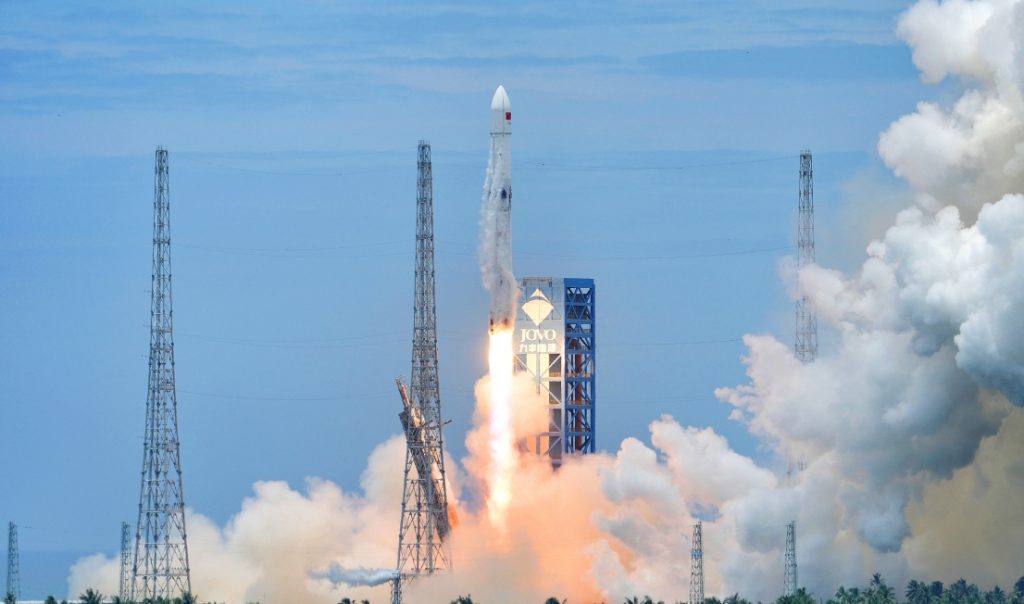
China’s state-owned space company has made significant strides in its reusable rocket technology, successfully launching a Long March orbital rocket and landing the booster on a seagoing recovery vessel. This achievement marks a major milestone in China’s space program and demonstrates its growing capabilities in the field.
The demonstration, which took place on Friday, showcases China’s Aerospace Science and Technology Corporation’s (CASC) ability to match the advances made by SpaceX, a leading player in the space industry. CASC’s Long March rocket is capable of carrying a payload similar to that of SpaceX’s workhorse Falcon 9, and the company plans to attempt to reuse the booster by the end of the year.
The key to China’s reusable rocket technology lies in its innovative approach to landing the booster. Unlike SpaceX’s Falcon 9, which uses landing legs to settle onto a floating platform, China’s approach involves using netting strung across a large frame onboard a recovery ship to capture the descending rocket. This method requires sophisticated guidance software and sensors, as well as reliable and rugged engines that can restart and survive the descent through the atmosphere.
Experts believe that China’s reusable rocket technology will have significant implications for the global space industry. Victoria Samson, the chief director for Space Security and Stability at the Secure World Foundation, calls the demonstration a ‘huge game changer’ that will ‘drop the launch cost for them tremendously.’ When China figures out how to reuse its rockets, it will be able to use them as part of its soft power outreach to launch things for potential allies very cheaply.
However, it’s worth noting that China’s reusable rocket technology will not directly compete with SpaceX’s launch customers due to national security rules that effectively split the global market for rockets between the U.S. and Europe on one hand, and Russia and China on the other. Nevertheless, China’s growing capabilities in the field will likely increase competition for SpaceX’s offerings, particularly in global markets such as Africa, the Middle East, and Southeast Asia.
The development of reusable rockets has significant implications for the U.S. military, as it could mean a diminished advantage in space. The U.S. has other companies working on reusable rockets, including Jeff Bezos’ Blue Origin, which recovered a booster in 2025 and reused it earlier this year. Blue Origin saw one of its rockets explode on the launch pad in May, delaying any further attempts for now. Rocket Lab has been working on Neutron, which is intended to fly with a reusable booster, while Stoke Space is developing a fully reusable rocket that it hopes to test this year.
The success of China’s reusable rocket technology is a testament to the country’s growing capabilities in the space industry. As the global space industry continues to evolve, it will be interesting to see how China’s reusable rocket technology impacts the market and the competition for launch customers.