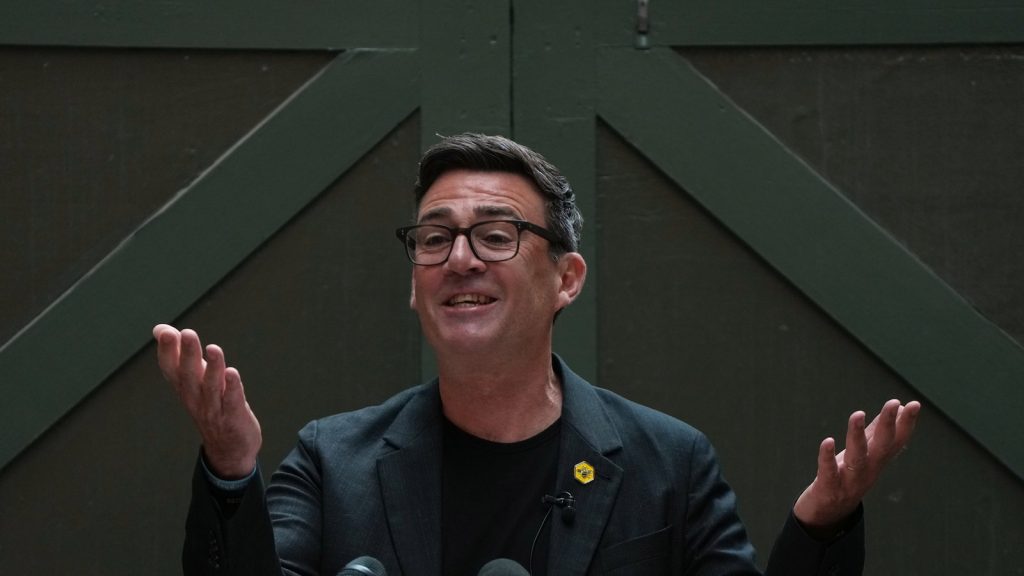
Labour Party’s Andy Burnham Set to Become Britain’s Next Prime Minister
London, UK – In a significant development, veteran Labour Party politician Andy Burnham is poised to become Britain’s next prime minister on Monday, succeeding Keir Starmer who announced his resignation last month. As the leader of the governing party, Burnham’s appointment is a result of his securing enough support from fellow Labour lawmakers to replace Starmer.
According to reports, Burnham received the backing of 349 out of 401 Labour Party lawmakers, making him the only candidate to meet the threshold required to replace Starmer as leader of the party. As a result, Burnham will formally take over as prime minister on Monday when he meets King Charles III at Buckingham Palace for a ceremonial handover.
Under Britain’s parliamentary democracy, governing parties can change leaders midterm without the need for a general election. Prime ministers can be replaced if they have resigned as party leader or have been forced out by a leadership challenge. This process is a common occurrence in British politics, with four of the six prime ministers in the past decade taking office through internal party leadership contests.
The next national election in the UK does not have to be held until 2029, five years after the last election in 2024. This has raised concerns among some critics who argue that the process undermines democratic principles. However, supporters of the system argue that it allows for a more efficient transfer of power and minimizes the disruption caused by a general election.
Starmer’s resignation was prompted by heavy losses suffered by Labour in a midterm set of local elections in May. The party’s poor performance led to mounting pressure on Starmer to step down, which he eventually did after barely two years in power. His decision to appoint a man with close ties to the late sex offender Jeffrey Epstein as Britain’s ambassador to the United States was also widely criticized.
Burnham’s appointment as prime minister is seen as a significant development in British politics, particularly given his popularity among Labour lawmakers. As he prepares to take office, Burnham is expected to face challenges in managing the party’s internal divisions and addressing the country’s pressing issues, including the ongoing impact of Brexit.
The transfer of power will be formalized on Monday with a ceremony at Buckingham Palace, where Burnham will meet King Charles III. The event is typically broadcast live on television and will mark the beginning of a new chapter in British politics.
How Britain’s Parliamentary System Works
Britain’s parliamentary democracy allows governing parties to change leaders midterm, with the winner becoming prime minister without the need for a general election. This process is a result of the country’s unique system of government, which combines elements of both parliamentary and presidential systems.
Under this system, the leader of the governing party becomes the prime minister, while the leader of the opposition party becomes the official opposition leader. This arrangement allows for a more efficient transfer of power and minimizes the disruption caused by a general election.
The process of replacing a prime minister is relatively straightforward. If the current prime minister resigns or is forced out by a leadership challenge, the party’s lawmakers will hold a leadership contest to choose a new leader. The winner of the contest becomes the new prime minister, who will then formally take office after meeting the monarch at Buckingham Palace.
A Look at the Recent History of Prime Ministerial Successions
Britain’s recent history has seen a rapid succession of prime ministers, with four of the six leaders in the past decade taking office through internal party leadership contests. This has raised concerns among some critics who argue that the process undermines democratic principles and creates uncertainty for the country.
However, supporters of the system argue that it allows for a more efficient transfer of power and minimizes the disruption caused by a general election. The recent history of prime ministerial successions in Britain is a complex and multifaceted issue, with various factors contributing to the rapid succession of leaders.
One of the key factors is the country’s unique system of government, which combines elements of both parliamentary and presidential systems. This system allows for a more efficient transfer of power and minimizes the disruption caused by a general election.
Another factor is the recent history of Labour Party leadership contests, which have seen a number of high-profile leaders come and go in a relatively short period of time. This has created uncertainty for the party and the country, with some critics arguing that the process undermines democratic principles.
Despite these challenges, Burnham’s appointment as prime minister is seen as a significant development in British politics. As he prepares to take office, he will face challenges in managing the party’s internal divisions and addressing the country’s pressing issues, including the ongoing impact of Brexit.