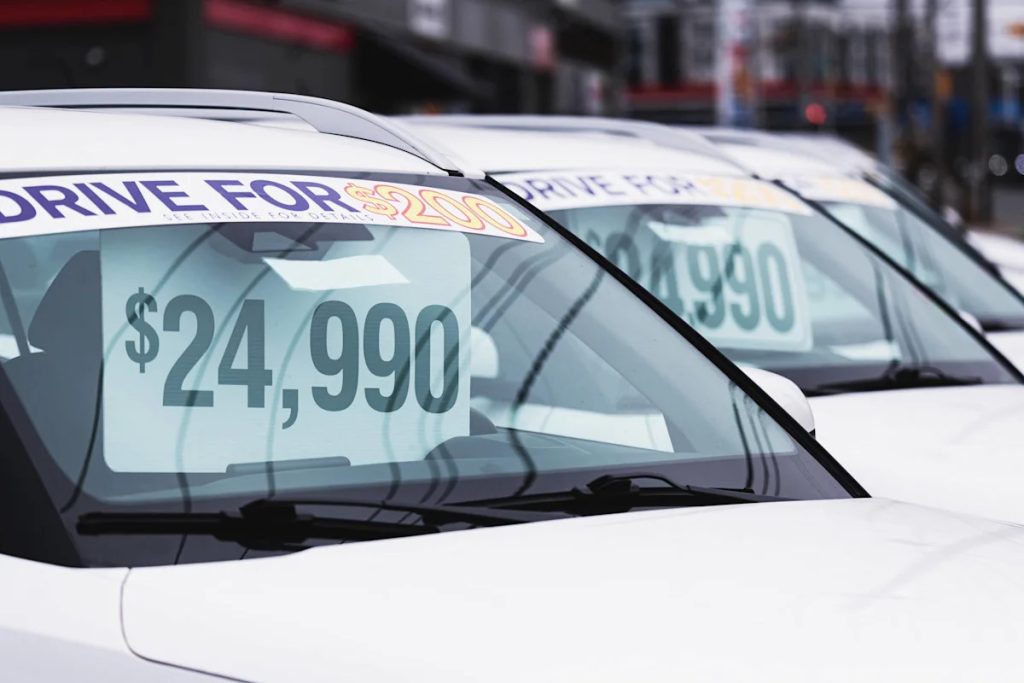
The used-car market has become increasingly challenging for buyers and sellers alike. In a recent move, America’s Car-Mart, one of the largest car dealerships in the country, has dramatically reduced its footprint by closing 40% of its locations. This drastic measure is a clear indication of the struggling state of the used-car market.
According to a recent report by Edmunds, the average monthly new-car payment has hit a record $777. This staggering figure is a result of the prolonged period of low interest rates and increasing car prices. To cope with these rising costs, many buyers are opting for longer loan terms, often stretching their payments over six or seven years. This approach may seem like a viable solution, but it can lead to a ‘mathematical trap,’ as Edmunds’ Ivan Drury puts it.
When paired with a 7.0% APR and an 84-month loan, buyers can end up handing over nearly $10,000 in interest alone. This can leave them ‘highly vulnerable to falling underwater,’ as Drury warns. The situation is equally dire for used-car buyers, who are financing an average of $30,414 at 10.5% interest. For subprime buyers, the situation is even more dire, with interest rates averaging a staggering 19.4% to 21.7%.
The pressure on car dealerships is not just limited to buyers. It is also affecting the dealerships themselves, particularly those that specialize in financing customers with weaker credit. America’s Car-Mart, which operates a chain of used-car dealerships, has reported a significant decline in revenue. The company’s total revenue for the period ended April 30, 2026, was $1.281 billion, down by 7.9% from fiscal 2025.
Despite the challenges, America’s Car-Mart has confirmed that it has consolidated 60 dealership locations in the period of 12 months. The company’s active dealership count decreased from 154 to 94, resulting in a 40% footprint reduction. The decision to close these locations was not taken lightly, and it is a clear indication of the company’s struggle to cope with the changing market conditions.
According to the company’s CEO, Doug Campbell, the decision to close the locations was a result of the limited origination capital and the lack of a revolving warehouse facility. The company intentionally reduced originations and inventory to protect liquidity and avoided originating loans it lacked the capacity to carry. This move has raised concerns about the company’s ability to continue operating, and it has issued a ‘going concern’ disclosure in its Form 10-K.
A ‘going concern’ disclosure is a warning sign that a company may not be able to continue operating for the foreseeable future. It is not a guarantee of bankruptcy, but it does indicate that the company is facing significant challenges. In the case of America’s Car-Mart, the company has specifically identified the ‘potential need to seek protection under applicable bankruptcy or insolvency laws’ as one of the risks it faces if it cannot secure additional financing or complete a strategic transaction.
The situation is dire for millions of working-class Americans who rely on their cars to get to work. In many communities, especially rural ones, ‘buy here, pay here’ dealerships are one of the few financing options available to borrowers with poor or limited credit histories. The closure of these dealerships can have a devastating impact on these communities, leaving many people without access to affordable transportation.
In conclusion, the used-car market is facing significant challenges, and America’s Car-Mart’s decision to close 40% of its locations is a clear indication of the struggle. The company’s ability to continue operating is uncertain, and it has issued a ‘going concern’ disclosure in its Form 10-K. The situation is dire for millions of working-class Americans who rely on their cars to get to work, and it highlights the need for more affordable transportation options.