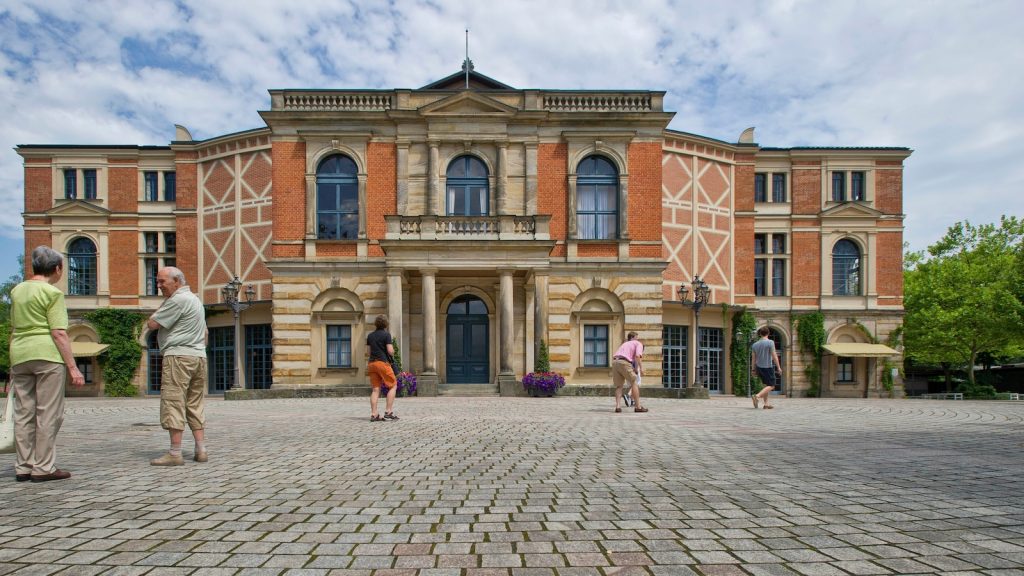
At the annual Richard Wagner festival in the German town of Bayreuth, an experiment with artificial intelligence has left the audience bewildered. The AI-assisted staging, which was part of the performance of ‘Götterdämmerung,’ drew boos and whistles from the audience after producing a visually striking yet confusing collage of images.
The Concept Behind the AI-Assisted Staging
The concept behind the AI-assisted staging was to create a visually immersive experience that would leave the audience in awe. According to the festival organizers, the AI would be used as an image-generating force, drawing from images pre-selected by the director of the Academy for Theater and Digitality in Dortmund, Marcus Lobbes, and his team. The AI would project scenes from previous performances of Wagner’s ‘Ring’ cycle and historical themes, creating a visually seething cosmos of light, texture, history, and association.
The festival organizers had touted the AI-assisted staging as a unique experience, stating that ‘every performance will be unique — because the images and associations never stand still.’ However, the audience seemed to be left confused by the AI-generated projections, which included scenes such as former German Chancellor Helmut Kohl, the towers of the World Trade Center after the Sept. 11, 2001 attacks, and a special postage stamp marking German reunification in 1990.
The Audience’s Reaction
The audience’s reaction to the AI-assisted staging was overwhelmingly negative. As the director and his team took to the stage at the end of the performance, they were greeted with boos and whistles. However, there was warm applause for the singers and musicians, particularly for conductor Christian Thielemann.
It’s worth noting that the AI-assisted staging was not without its supporters. Some audience members were seen taking photos and videos of the projections, and a few were even seen nodding their heads in approval. However, the majority of the audience seemed to be left confused and disappointed by the experiment.
The Future of AI in Theater
The use of AI in theater is a relatively new concept, and the Richard Wagner festival’s experiment with AI-assisted staging is one of the first of its kind. While the audience’s reaction to the experiment was largely negative, it’s clear that the use of AI in theater has the potential to be a game-changer. With the ability to create complex and immersive visual experiences, AI could revolutionize the way we experience live theater.
However, it’s also clear that the use of AI in theater is not without its challenges. As the Richard Wagner festival’s experiment showed, the use of AI can also lead to confusion and disappointment. As the use of AI in theater continues to evolve, it will be interesting to see how it is used and how it is received by audiences.
The festival organizers have stated that they will continue to use AI in their performances, and that they will work to refine the technology to better meet the needs of their audience. Only time will tell if the use of AI in theater will become a staple of the industry, or if it will remain a niche experiment.
Conclusion
The Richard Wagner festival’s experiment with AI-assisted staging has left a lasting impression on the audience and on the industry as a whole. While the use of AI in theater has the potential to be a game-changer, it’s clear that it’s still in its infancy. As the use of AI in theater continues to evolve, it will be interesting to see how it is used and how it is received by audiences.
In the meantime, the Richard Wagner festival’s experiment serves as a reminder that innovation and experimentation are essential to the growth and evolution of any art form.
Whether or not the use of AI in theater will become a staple of the industry remains to be seen. However, one thing is certain: the Richard Wagner festival’s experiment has opened the door to a new world of possibilities, and it will be exciting to see where this new technology takes us.