Taiwan’s Annual Military Drills: A Show of Strength Against China
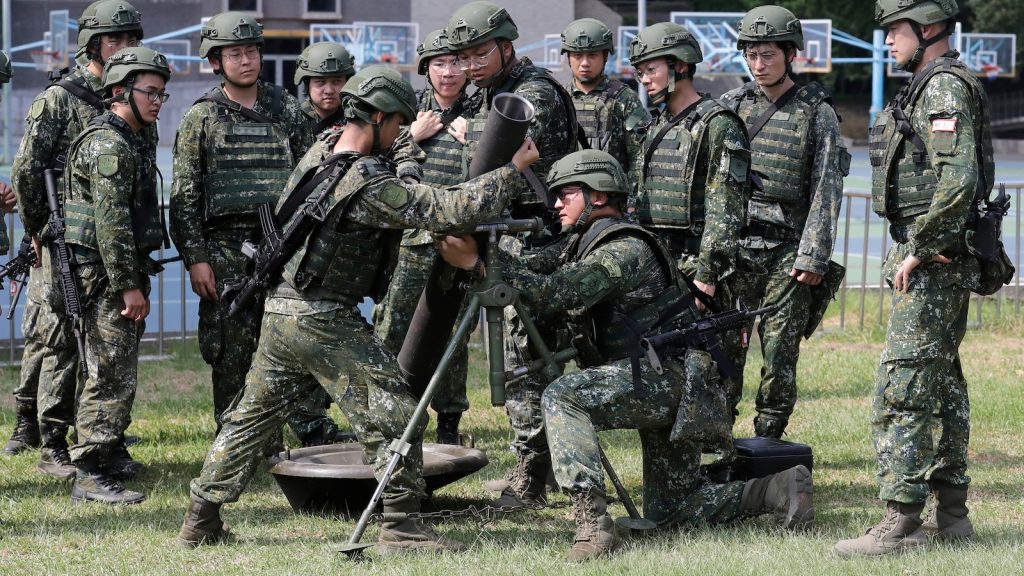
Taiwan has commenced its annual Han Kuang military exercises, aimed at simulating a response to a potential Chinese invasion. The live-fire drills will test the Taiwanese army’s ability to sustain 24-hour defense operations and counter China’s ‘gray-zone tactics,’ which stop just short of open warfare.
The 10-day exercises will be held in various locations around the island, with a focus on new communication methods inspired by the US. These include backbriefs, where subordinates explain to commanders how they plan to carry out assigned missions. This approach is intended to encourage first-line fighters to be more self-reliant and effective in battle.
Another key aspect of this year’s drills is the mobilization of the largest ever team of reservists, with over 5,000 service members across two brigades. Last year’s drills involved one brigade of more than 3,000 reservists. The drills will test how quickly reserves can mobilize from peacetime standby mode to full active duty.
The exercises will also feature urban resilience drills, which will take place on different days in major cities like Kaohsiung, Taichung, and Taipei. During the drills, mobile internet speed will be reduced for about 30 minutes to simulate telecommunications interference in case of an attack.
Taiwan will be testing military equipment, including the newly acquired M1A2T Abrams tanks. The island procured 108 of these American-made tanks in 2019, with the last batch arriving in April. Taiwan sources most of its weapons from the US, its main informal backer in the face of territorial claims from China.
Beijing regards democratic Taiwan as a breakaway province, to be retaken by force if necessary. In recent years, China has ramped up a campaign of military pressure, involving the sending of military aircraft and warships near the island almost daily. Taiwan’s parliament recently approved a $24.8 billion supplementary budget bill for the purchase of US arms, which fell short of Taiwanese President Lai Ching-te’s proposal for a $40 billion budget.
The island’s government is waiting on the US to greenlight a $14 billion arms sale package to Taiwan, which has been held up for months. US President Donald Trump and the US Congress earlier approved a separate, record-breaking $11 billion package. However, after traveling to China in May, Trump described arms sales to Taiwan as a ‘good negotiating chip’ with Beijing and refrained from approving the newest arms sales package to Taiwan.
Overall, the Han Kuang exercises demonstrate Taiwan’s commitment to its national defense and its determination to counter the growing military pressure from China.
Here are some key statistics and facts about the Han Kuang exercises:
- The exercises will be held in various locations around the island.
- The drills will test new communication methods inspired by the US.
- Over 5,000 reservists will be mobilized for the exercises.
- The drills will feature urban resilience drills to test the population’s response to a disruption in internet service.
- Taiwan will be testing military equipment, including the M1A2T Abrams tanks.