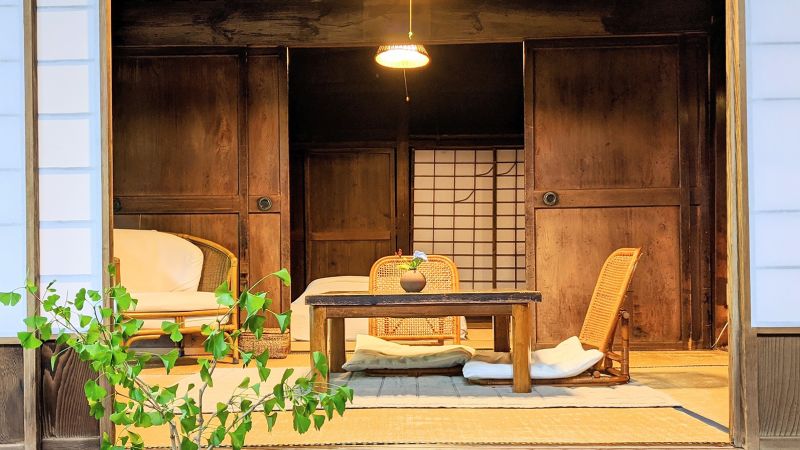
A Dream Realized
CNN Travel spoke with Daisuke Kajiyama, a Japanese traveler who had spent years backpacking around the world, about his journey to turn an abandoned ‘ghost house’ in Japan’s countryside into a charming guesthouse.

Source: media.cnn.com
After years of globetrotting to destinations like Korea, Taiwan, India, Nepal, Guatemala, Cuba, and Canada, Kajiyama returned to Japan with his Israeli partner Hila, whom he met in Nepal. Together, they set out to find the perfect location for their future guesthouse.

Source: media.cnn.com
However, their search was not without its challenges. Kajiyama had very little money to speak of after years of traveling, and he also had his heart set on a traditional Japanese house, typically known as a kominka, which are usually passed down over generations.

Source: media.cnn.com
‘I wanted to have a traditional house in the countryside,’ Kajiyama explained. ‘I had a vision.’
When Kajiyama was unable to find anything that met his requirements, he decided to shift his search to include the growing number of abandoned homes in the country, known as akiya. These homes are often left vacant as younger people move to cities in pursuit of jobs.
According to the Japan Policy Forum, there were 61 million houses and 52 million households in Japan in 2013, and with the country’s population expected to decline from 127 million to about 88 million by 2065, this number is likely to increase.
Kajiyama’s search led him to a small village in the Shizuoka prefecture, where he met an elderly woman who was farming. She pointed him in the direction of two neglected houses side by side – a former green tea factory and an old farmer’s home – located close to a river.
Both properties had been uninhabited for at least seven years and needed a huge amount of work. Kajiyama asked the woman to contact the owner to find out if they’d be interested in selling.
A Traditional Vision
Kajiyama returned to visit the houses around five times, before going to visit the owner himself to negotiate an agreement that would see him use the old green tea factory as a home, and convert the farmer’s house into the guesthouse he’d always envisioned.
While he was keen to purchase both of the homes, Kajiyama explained that the traditions around home ownership in Japan mean that he is unable to do so until it’s passed down to the son of the current owner.
‘They said ‘if you take all the responsibility yourself, you can take it.’ So we made an agreement on paper,’ Kajiyama said.
Both he and Hila were aware that they had a lot of work ahead of them, but the couple were thrilled to be one step closer to having their own guesthouse in an ideal spot.
‘It’s a very nice location,’ Kajiyama said. ‘It’s close to the city, but it’s really countryside. Also people still live here and go to work [in the city].
The house is also in front of the river, so when you go to sleep you can hear the sound of the water.’
A Labor of Love
According to Kajiyama, the process of clearing the house, which is around 90 years old, before beginning the renovation works was one of the hardest parts of the process, simply because there was so much stuff to sort through.
However, he was able to repurpose some of the items. During the first year, he spent a lot of time connecting with locals, gaining knowledge about the home, and helping the local farmers with farming for the first year or so.
Although he wasn’t hugely experienced with renovation work, Kajiyama had spent some time farming and completing building while he was backpacking, and had also taken odd jobs fixing peoples homes.
He completed much of the work on the guesthouse himself, replacing the floors and adding in a toilet, which he says was a wedding present from his parents, at a cost of around $10,000.
‘I’m not really a professional,’ Kajiyama said. ‘I like to do carpentry and I enjoy creating things, but I have no experience in my background.
From my several years of backpacking, I saw so many interesting buildings, so many houses of interesting shapes and I’ve been collecting those in my brain.’
Kajiyama was determined to keep the house as authentic as possible by using traditional materials. He saved money by collecting traditional wood from building companies who were in the process of breaking down traditional houses.
‘They need to spend the money to throw it away,’ Kajiyama explained. ‘But for me, some of the stuff is like treasure. So I would go and take the material that I wanted.’
Agricultural Guesthouse
After doing some research into Japanese guesthouse permits, Kajiyama discovered that one of the simplest ways to acquire one would be to register the property as an agriculture guesthouse.
As the area is filled with bamboo forests, this seemed like a no-brainer, and Kajiyama decided to learn everything he could about bamboo farming so that he could combine the two businesses.
‘This is how I started farming,’ Kajiyama said.
In 2014, two years after they began working on the house, the couple were finally able to welcome their first guests.
‘It was a beautiful feeling,’ Kajiyama said. ‘Of course, this was my dream. But people really appreciate that it was abandoned and I brought it back to life.’
Kajiyama says that hosting guests from all over the world has helped him to stay connected to his former life as a backpacker.
‘I stay in one place, but people come to me and I feel like I’m traveling,’ Kajiyama said. ‘Today, it’s Australia, tomorrow it’s the UK and next week South Africa and India.
People come from different places and they invite me to join them for dinner, so sometimes I join someone’s family life.’
Sadly, Hila passed away from cancer in 2022. Kajiyama stresses that his beloved wife played a huge part in helping him achieve his dream of having a guesthouse and says he couldn’t have done it without her.
‘We were really together,’ Kajiyama added. ‘She created this place with me. Without her it would not have been like this.’
While the three-bedroom guesthouse, which measures around 80 square meters, has been open for around eight years, Kajiyama is still working on it, and says he has no idea when he’ll be finished.
‘It’s never ending,’ Kajiyama admitted. ‘I’m halfway, I feel. It is beautiful already. But it started off abandoned, so it needs more details. And I’m getting better at creating, so I need time to do it.’
Kajiyama’s journey is a testament to the power of perseverance and creativity. From an abandoned ‘ghost house’ to a charming guesthouse, Kajiyama’s vision has come to life, and it’s a must-visit destination for anyone looking to experience the authentic beauty of Japan’s countryside.