Australia and India Reach a Landmark Agreement on Uranium Exports
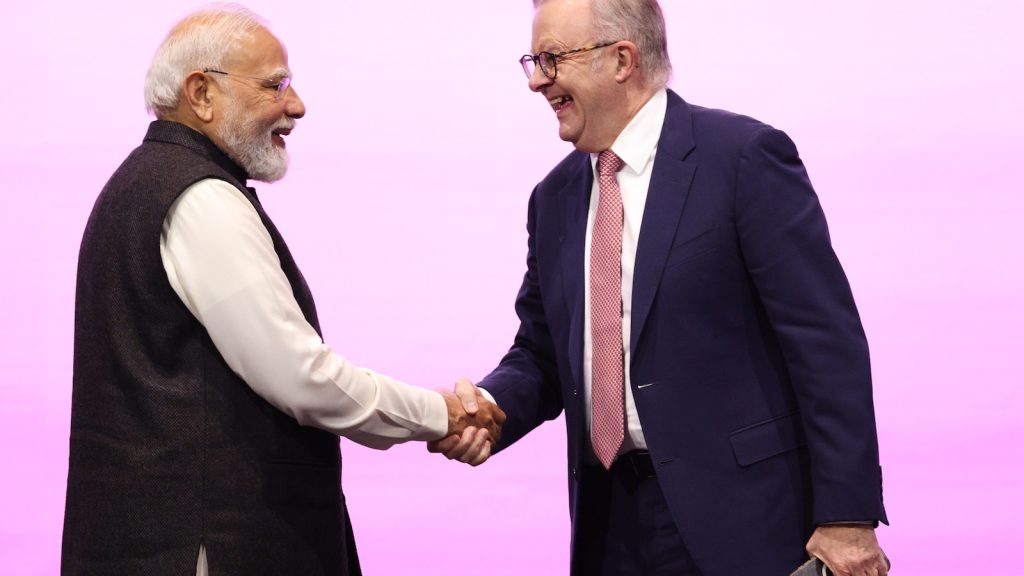
Australia has finally agreed to sell uranium to India for peaceful purposes, ending a long-standing stalemate that had been in place for years. The agreement was reached after Australian Prime Minister Anthony Albanese and Indian Prime Minister Narendra Modi met in Melbourne and signed an administrative deal to facilitate the exports of the material.
The decision marks a significant shift in Australia’s stance on uranium exports, which had been stalled since 2014 due to concerns about the potential use of the material for nuclear weapons. India, which has a growing middle class and a population of 1.4 billion people, wants to install 100 gigawatts of nuclear power by 2047, which would be enough to power nearly 60 million Indian homes a year.
India has doubled its nuclear power installations in the last decade, but this still accounts for only 3% of its electricity. The country is not a signatory to the Nuclear Non-Proliferation Treaty, which recognizes only the United States, China, Britain, France, and Russia as nuclear weapons powers. Australia, on the other hand, is a signatory to the treaty and had refused to sell uranium to non-signatories.
However, in recent years, Australia’s position has eased, and the country has agreed to allow exports of uranium to India subject to certain conditions. These conditions include the separation of the Indian civilian and military nuclear programs and the application of International Atomic Energy Agency Safeguards.
The agreement is a significant boost to India’s plans to increase its nuclear power capacity, which would help meet its growing energy demands. The two countries have also pledged to strengthen their defense and security cooperation in the Indo-Pacific region, reflecting a step-change in the depth and ambition of their relationship.
The agreement is expected to have a significant impact on trade between the two countries, with India being Australia’s fifth-largest trading partner. The two-way trade in goods and services was valued at AUD 54.4 billion (USD 37.7 billion) in the 2024-2025 financial year.
Modi’s visit to Australia is part of an annual leaders’ summit between the two countries, and the two leaders have also pledged to strengthen their bilateral ties in areas such as trade, defense, and security.
The agreement is a significant step forward in Australia’s relations with India and reflects the growing importance of the Indo-Pacific region in the country’s foreign policy. It is also a significant victory for India’s efforts to increase its nuclear power capacity and meet its growing energy demands.
The agreement has been welcomed by both countries, and it is expected to have a positive impact on their bilateral relations in the coming years. The agreement is a significant milestone in the history of Australia-India relations and reflects the growing importance of the Indo-Pacific region in the country’s foreign policy.
Australia’s Uranium Exports to India: Key Facts
- Australia has agreed to sell uranium to India for peaceful purposes.
- The agreement was reached after Australian Prime Minister Anthony Albanese and Indian Prime Minister Narendra Modi met in Melbourne.
- The decision marks a significant shift in Australia’s stance on uranium exports, which had been stalled since 2014.
- India wants to install 100 gigawatts of nuclear power by 2047, which would be enough to power nearly 60 million Indian homes a year.
- India has doubled its nuclear power installations in the last decade, but this still accounts for only 3% of its electricity.
- Australia is a signatory to the Nuclear Non-Proliferation Treaty and had refused to sell uranium to non-signatories.
- The agreement is subject to certain conditions, including the separation of the Indian civilian and military nuclear programs and the application of International Atomic Energy Agency Safeguards.