Reevaluating Our Assumptions about UFOs
Throughout history, the phenomenon of UFO sightings has forced us to confront our often unfounded assumptions about the nature of these enigmatic objects.
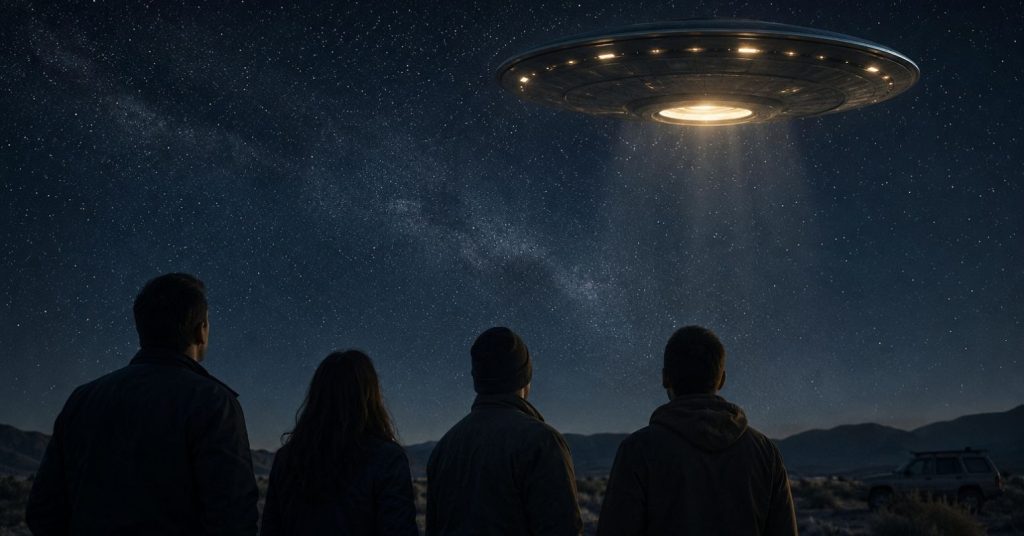
One of the most pervasive and consistent assumptions is that the unidentified objects seen in the night sky are vehicles or crafts, and that the beings inside these crafts are the primary focus of interest. However, what if this assumption is mistaken? What if the craft or vehicle itself is what’s truly alien?
The long history of UFO sightings can be seen as a reflecting pool for human nature, revealing our subconscious beliefs and assumptions. The term ‘flying saucer’ has been around since the late 1940s, describing a disk-shaped object in the sky with lights or doors that suggest the object opens to allow for entry and exit.
UFO lore is filled with stories of mysterious and elusive beings inside these disk-shaped crafts, commonly described as little gray beings with two eyes, one nose, one mouth, two arms, and two legs, which sounds suspiciously similar to human beings. Neil deGrasse Tyson points out in his latest book, Take Me to Your Leader, that this similarity raises questions about why beings from a distant corner of our universe or another universe entirely would have so much in common with us.
Recent years have given rise to more innovative and differently conceived ‘aliens,’ such as insect-like beings, octopus-like entities, or even cloud formations. These alternative depictions challenge our traditional notions of what it means to be ‘alien.’
Our search for extraterrestrial intelligence has been surprisingly human-centric, with SETI’s long-standing habit of sending radio signals and media out into the universe in hopes of getting a response. However, we do not know what aliens are like, if they exist at all, and maybe our human imagination cannot even conceive of what they might be like.
Why not assume that the UFO crafts themselves are the aliens? This perspective challenges our conventional thinking and forces us to reevaluate our assumptions about the nature of these enigmatic objects.
Some far-out hypotheses suggest that these crafts are manifestations of ourselves from the future visiting current reality or that they are programs briefly rendered real in a simulated reality. If the craft is the being, then where are we getting all these ideas and images of so-called ‘little green men’? Perhaps the most robust accounts of UFOs come from highly trained professionals like military personnel and pilots, who typically describe only the craft or vehicle and not little inhabitants.
Rethinking the term ‘alien’ could be a good starting point for beginning to ‘identify’ these unidentified flying objects. ‘Alien’ has become synonymous with the green alien face we see everywhere in pop culture, but what if it refers not to the creature itself but to the layer of space or even dimension of time instead? Perhaps these crafts are from an alien time period or an alien space.
Rethinking our assumptions around UFOs and aliens is a good starting point for beginning to understand these enigmatic objects. By challenging our conventional thinking and exploring alternative perspectives, we may uncover new insights into the nature of these mysterious phenomena.