The United States, the United Kingdom, and a dozen other Western and Asian countries have reaffirmed their stance on the 2016 arbitration ruling that declared China’s expansive claims in the South China Sea as illegal.
Joint Statement Issued by 14 Nations
A joint statement issued by the 14 nations, including the Philippines, Japan, Australia, New Zealand, Canada, Germany, Italy, Estonia, Latvia, Lithuania, Romania, and Slovenia, stated that they reject ‘destabilizing’ actions in the disputed waters that threaten regional peace.
The statement commemorated the July 12, 2016, arbitration ruling by a tribunal established in The Hague under the United Nations Convention on the Law of the Sea, saying the landmark decision is ‘a significant milestone and is final, legally binding, and definitive.’
China refused to join the arbitration initiated by the Philippines in 2013 after a tense standoff in the contested waters a year earlier that ended with Beijing effectively seizing a disputed shoal.
Beijing rejected the 2016 ruling and continues to defend its claims to virtually the entire sea passage, a key global trade route that has long been feared as one of Asia’s most active flashpoints.
The areas have been the scene of repeated territorial standoffs involving China and the Philippines, Vietnam, Malaysia, Brunei, and Taiwan.
The joint statement emphasized that the nations ‘reaffirm the Arbitral Tribunal’s decision that there is no legal basis for China’s expansive maritime claims in the South China Sea, including those based on ‘historic rights.’
Background on the 2016 Arbitration Ruling
The arbitration tribunal largely decided in favor of the Philippines, ruling that under the U.N. Convention on the Law of the Sea, ‘there was no legal basis for China to claim historic rights to resources’ in the South China Sea outside of its regular territorial areas recognized under the convention.
The convention, largely regarded as the treaty governing the world’s oceans and seas, took effect in 1994 and has been ratified by more than 170 countries and parties, including China and the Philippines.
The tribunal’s decision was a significant milestone in the ongoing dispute over China’s claims in the South China Sea, and the joint statement reaffirmed the nations’ commitment to upholding the principles of the convention.
The nations stressed ‘our strong opposition to any destabilizing or unilateral actions, including by force or coercion, that threaten peace and stability in the region.’
They also emphasized the importance of ‘upholding freedom of navigation and overflight as well as other internationally lawful uses of the sea as reflected in UNCLOS.’
The territorial disputes in the South China Sea should be resolved peacefully based on the 1982 U.N. convention, the nations stated.
China did not immediately respond to the joint statement, but in a recent statement issued through its embassy in Manila, Beijing said it would never recognize the 2016 ruling that it called ‘illegal, null, and void.’
Beijing stated that the ruling ‘will not alter the historical and factual basis for China’s sovereignty over the islands of the South China Sea and their adjacent waters.’
The Chinese embassy in Manila added that the ruling ‘will not weaken China’s resolve and determination to safeguard its sovereignty and maritime rights and interests.’
The United States has repeatedly called on China to comply with the arbitration ruling, and the former Biden and current Trump administrations have both warned that Washington is obligated to defend the Philippines, its oldest treaty ally in Asia, if Filipino forces, vessels, or aircraft come under an armed attack in the disputed waters.
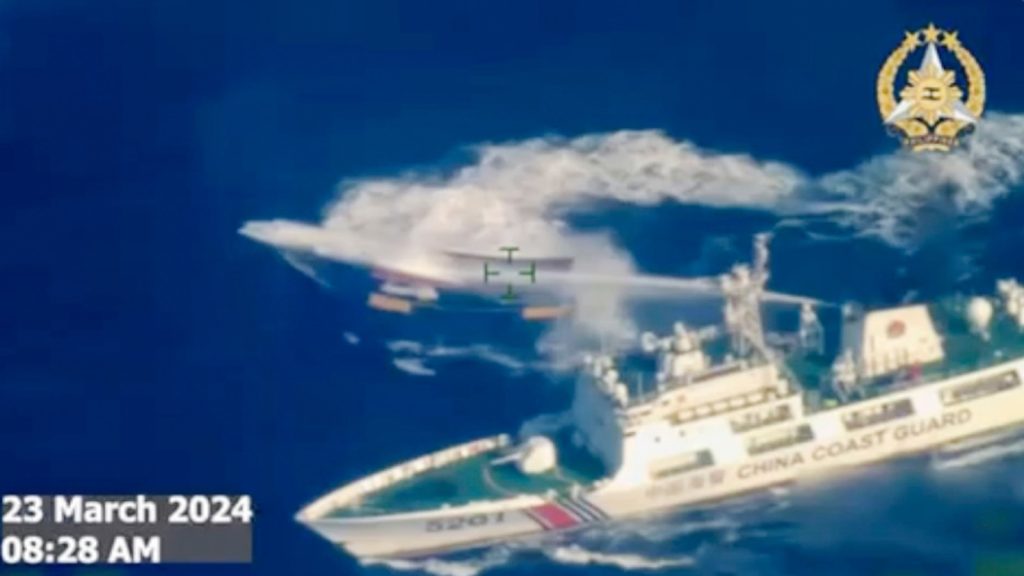
Chinese coast guard ships and support vessels have used powerful water cannons, military-grade lasers, and dangerous blocking maneuvers against Philippine forces and fishermen from rival claimant countries, leading to collisions in the high seas and high-risk encounters in the air.
The recent tensions in the South China Sea have raised concerns about regional stability and the potential for conflict.