China’s ‘Green Great Wall’ Tames Desert Growth, But Scientists Warn the Fight Is Not Over
For half a century, workers in northern China have been using a technique called ‘straw checkerboards’ to combat desertification. This simple yet effective method has helped to stabilize sand dunes against the wind and promote plant growth by providing water through an irrigation system.
The widespread lattice created across the sand has become the iconic image of China’s decades-long campaign against desert conditions, known as the Three-North Protective Forest Program or the Green Great Wall.
Generations of work have yielded measurable progress, with the area of desertified land in northern China peaking in 2000 and reducing by over 1,000 square kilometers each year since then, according to data published by state media.
The Chinese government has stated that the initiative launched in 1978 has played a crucial role in transforming vast regions covering nearly half of China from ‘the desertification advancing and people retreating’ to ‘greenery advancing and the desertification retreating.’ Forests planted by the program now cover a cumulative 500,000 square kilometers.
Chief scientist for the U.N. Convention to Combat Desertification, Barron Joseph Orr, said that reversing desertification is possible when it becomes part of long-term development strategies.
Scientist Zhu Jiaojun, who has long been dedicated to the construction and management of the program, stated that increased rainfall in recent years in some areas has made vegetation restoration easier.
According to long-term monitoring data by Zhu’s team, China’s desertified land has shrunk by around 10% overall since 2000, and areas of severely or extremely desertified land have decreased by more than 40%. Forest cover in the program area has risen from around 5% in 1978 to 14% in 2022.
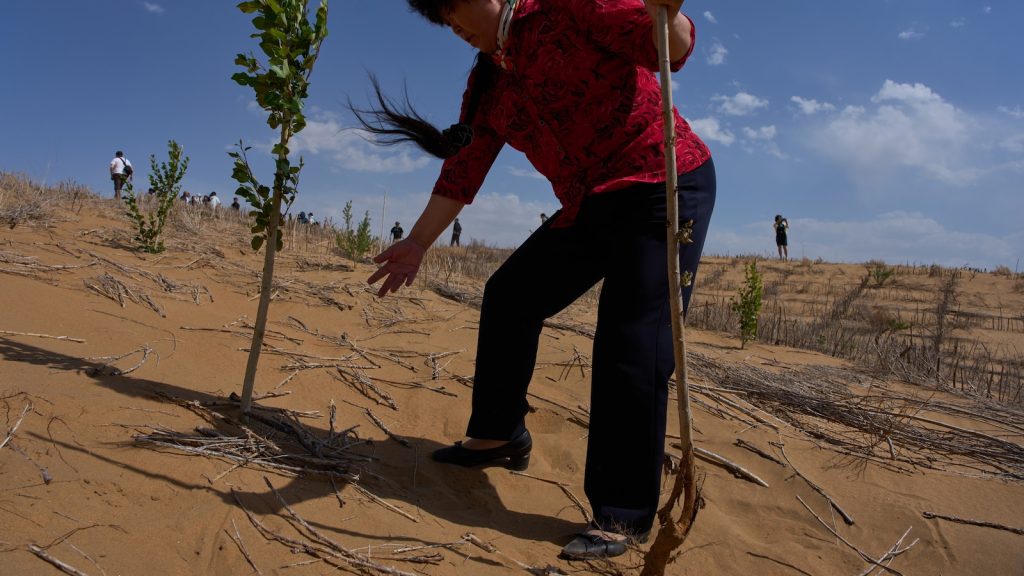
Local sand-control workers, like 60-year-old Yin Yuzhen, have been working tirelessly to maintain the checkerboards and plant trees. Yin recalled her early days of being a sand-control worker as ‘very lonely,’ but now feels a sense of pride and accomplishment as she sees the greenery advancing.
Zhu estimated that over 300 million rural laborers have been involved in the program, mostly on a paid, part-time basis. The environmental advocacy group Green Camel Bell in Gansu province works to explain desertification and its risks to farmers and herders, plant trees with them in dryland areas, and help restore and sustain vegetation.
Efforts to combat desertification and restore forests should be linked to local livelihoods, so communities do not see economic development and ecological protection as an either-or choice, said Zhao Zhong, founder of the Green Camel Bell.
Zhu emphasized that a key question for the project is how conservation can be sustained if the scale of human intervention and investment is reduced.
Yin hopes the younger generation will continue her work and teach them to love the Earth, as ‘nature will love us in return.’