Fantasy Football Tight End Tiers: A Round-by-Round Plan for Drafting TEs in 2026
As fantasy analysts, we’ve all been guilty of saying ‘this is the year of the tight end’ when we get a quality group of players at the position. And, indeed, if you said it in 2025, you were right. With 15 tight ends averaging at least 8.0 half-PPR points per game last season, it’s clear that the position is becoming increasingly important in fantasy football.
Last year’s standout rookie class, which included Harold Fannin Jr., Tyler Warren, and Colston Loveland, played a significant role in this increased production. The old guard of George Kittle, Travis Kelce, Dallas Goedert, and Hunter Henry were still successful, while Trey McBride dominated the position, and Tucker Kraft, Brock Bowers, and Kyle Pitts all had quality campaigns.
Most of those tight ends should be productive again in 2026, and we have high expectations for others like Sam LaPorta, Isaiah Likely, and Chigoziem Okonkwo. To help fantasy managers navigate the position, I’ve created a set of tight end tiers that can serve as a guide on Draft Day.
Rounds 2 and 3
Top of the list is Brock Bowers, who I believe will lead the position in targets and finish as the best Fantasy tight end in 2026. He’s worth drafting as early as the middle of Round 2. Bowers had an amazing rookie campaign in 2024 with 112 catches for 1,194 yards and five touchdowns on 153 targets. However, injuries and a struggling offense limited his production in 2025 to 64 catches for 680 yards and seven touchdowns on 86 targets in 12 games. If Bowers stays healthy, he could be a candidate for Fantasy MVP this year.
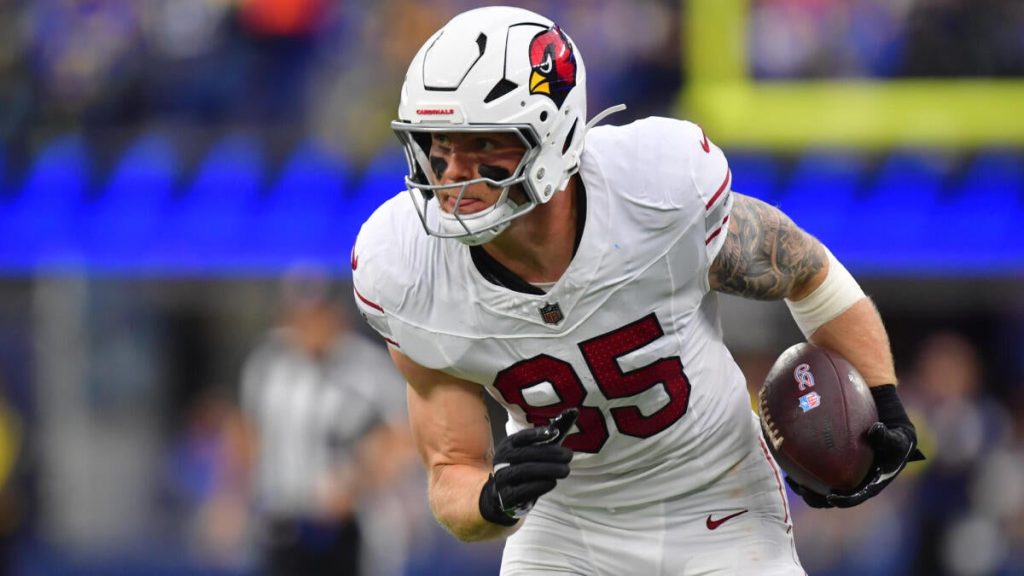
Trey McBride averaged 14.4 half-PPR points per game last season, and the next closest tight end was Kraft at 12.1. McBride led the position in targets (169), catches (126), and yards (1,239), and he tied Goedert for the touchdown lead with 11. While it was a magical season, I’m expecting some regression this year, as the Cardinals’ run game should improve dramatically with the addition of Jeremiyah Love and Tyler Allgeier, along with James Conner being healthy. Marvin Harrison Jr. will hopefully stay healthy all season, and Michael Wilson will improve. McBride should still be awesome, but I would draft him after Bowers in early Round 3.
Rounds 3-7
This tier starts with Colston Loveland as early as Round 3. I would prefer to draft him in Round 4, but that might not be realistic given his upside. Loveland got off to a slow start as a rookie due to injury and inconsistent play. However, from Week 12 on, including the playoffs, he scored at least 10 half-PPR points in five of his final nine games. In his final four outings, Loveland averaged 16.0 half-PPR points per game, with at least 10 targets per game in all four contests. He averaged seven catches and 94.5 yards per game, with two touchdowns. Loveland should be a star this season.
Tyler Warren was spectacular when Daniel Jones was healthy through the first 10 weeks of the season. He scored at least 10.5 half-PPR points in six of 10 games, and we hope he can pick up from that point in 2026 now that it appears Jones will be ready for Week 1. Warren should also benefit with Michael Pittman being gone and no significant replacement added. I would draft Warren as early as Round 4.
Sam LaPorta was a star in 2023 when he averaged 11.0 half-PPR points per game as a rookie. He struggled in 2024 at 8.6 half-PPR points per game, and he dealt with a back injury in 2025 when he finished with 9.1 half-PPR points per game in just nine contests. We hope he’s healthy for Week 1, and LaPorta has top-five upside with Drew Petzing as the new offensive coordinator in Detroit. Petzing loves using his tight ends, and he was just the coordinator in Arizona for the past four seasons with McBride. LaPorta is worth drafting as early as Round 5.
Tucker Kraft was on his way toward having a massive season in 2025 before he suffered a torn ACL in Week 9. Through his first seven games of the year, Kraft scored at least 11 half-PPR points four times, and he could see a boost in production if healthy since Romeo Doubs and Dontayvion Wicks are no longer in Green Bay. We expect Kraft to play in Week 1, and he’s worth drafting no later than Round 7.
Kyle Pitts rebounded in 2025 after three down seasons in a row when he averaged a career-best 9.2 half-PPR points per game. He should continue to play at a high level with Kevin Stefanski as the new head coach in Atlanta, and Stefanski has a great track record with tight ends (see David Njoku and Fannin as examples). The Falcons should have concentrated targets for Drake London, Pitts, and Bijan Robinson, and Pitts had 118 targets in 2025, which was second among all tight ends. That number could improve this season thanks to Stefanski, and Pitts is worth drafting as early as Round 6.
Harold Fannin was awesome in his rookie campaign in 2025 when he had 72 catches for 731 yards and six touchdowns on 107 targets, which led the Browns. I hope he can lead Cleveland in targets again this year, but that could be an issue after the Browns drafted K.C. Concepcion in Round 1 of the NFL Draft and Denzel Boston in Round 2. It’s a much improved receiving corps, and we’ll see if Fannin can develop a rapport with Deshaun Watson, who hasn’t played since 2024. I like Fannin this season, but the earliest I would draft him is Round 7.
Rounds 8-10
George Kittle, 32, is coming off an Achilles injury that he suffered in the wild-card round of the NFL playoffs, but he’s tracking to be ready for Week 1. It’s risky to draft Kittle as a top-five Fantasy tight end, but he is still worth the risk as a top-10 option in Round 8 or later. Kittle has averaged at least 10.1 half-PPR points per game for eight years in a row, and hopefully the new additions in San Francisco (Mike Evans, Christian Kirk, and De’Zhaun Stribling) don’t take away too much from Kittle remaining a focal point for Brock Purdy.
Travis Kelce, 36, was having a solid campaign in 2025 when Patrick Mahomes was healthy, and Kelce averaged 9.9 half-PPR points per game in the first 14 games of the year. To put that in perspective, the only tight ends with a better average for the season in 2025 were McBride, Kraft, Kittle, and Bowers. Mahomes is on track to play in Week 1, and Kelce could have one more quality season before he likely retires. He’s a good fallback option in Round 8 or later.
Isaiah Likely has been waiting for his chance to shine, and he finally gets that this season after leaving Baltimore for the Giants. In his four-year career with the Ravens, Likely has nine games with at least six targets. He scored at least 9.5 half-PPR points in eight of them and averaged 13.4 half-PPR points over that span. We’ll see what happens with Malik Nabers early in the season, but Likely should be second on the Giants in targets this year. He’s worth drafting in Round 9.
Rounds 10-14
Chigoziem Okonkwo should be second on the team in targets behind Terry McLaurin if Washington doesn’t add another pass catcher of significance. The Commanders lost Deebo Samuel (99 targets) and Za’Darius Smith, and Okonkwo could see an increase in targets. He’s worth drafting in Round 10.
Dallas Goedert had a solid season in 2025, and he’s worth drafting in Round 10. He’s a consistent producer, and he could see an increase in targets with the Eagles’ receiving corps.
Mark Andrews has been a reliable tight end for years, and he’s worth drafting in Round 12. He’s a consistent producer, and he could see an increase in targets with the Ravens’ receiving corps.
Dalton Kincaid has top-five upside with the Bengals, and he’s worth drafting in Round 12. He’s a rookie tight end, but he could see an increase in targets with the Bengals’ receiving corps.