South Korea Apologizes Over Police Handling of Murder Case, Announces Sweeping Reforms
The government of South Korea has apologized for the mishandling of the Jang Yun-gi murder case, announcing a series of reforms aimed at eradicating corruption within the police force and strengthening democratic oversight.
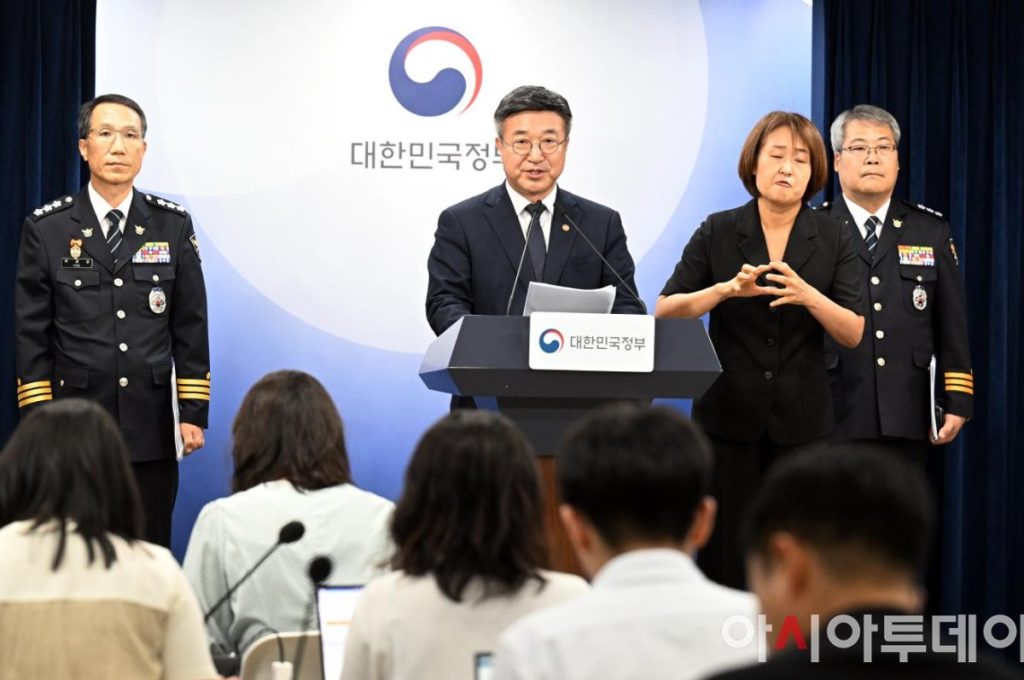
Interior and Safety Minister Yoon Ho-jung announced the measures during a public address at the Government Complex Seoul, stating that the head of the investigative team in the Jang Yun-gi case has been arrested on suspicion of destroying evidence and that indications of deliberate collusion and preferential treatment by the investigation team are emerging.
Yoon expressed his deepest condolences and sympathy to the victim’s family and apologized for causing concern to the public, stating that the government would overhaul the investigative system and remove officers involved in corruption to restore public trust damaged by negligent and concealed investigations.
The government plans to introduce a comprehensive rotation system for police personnel to prevent improper relationships based on regional ties. Police officers would be required to report cases involving their spouses, parents, grandparents, children, or grandchildren, and would then be removed from those investigations under a conflict-of-interest system.
The current rotation periods for police personnel are as follows: senior superintendents are generally reassigned every year, while superintendents rotate every one to two years and inspectors every four to five years. A police reform task force will consider whether different rotation periods should apply to investigative team leaders and working-level investigators.
The government will also establish an internal corruption investigation unit reporting directly to the head of the National Office of Investigation, which will investigate corruption and misconduct involving officers at local police stations, provincial police agencies, the Korean National Police Agency, and the National Office of Investigation.
An independent investigation and human rights oversight body will also be established under the National Police Commission to monitor police investigations. Civilian investigators with specialized expertise will independently examine negligent or unfair investigations and cases in which police fail to comply with prosecutors’ requests for supplementary investigations.
The National Police Commission will use the findings to request disciplinary or personnel action from the commissioner general of the Korean National Police Agency. The government is initially considering an organization of about 100 investigators, with plans to staff it mostly with civilian investigators and exclude active-duty police officers.
Whether former police officers may participate and the specific qualifications required of investigators will be determined through legislation and public hearings. The government also plans to reorganize police investigation review committees to center them on citizens and outside experts, expanding the types of cases involving socially vulnerable people in which objections may be filed.
Additional checks and balances are planned between the police and the Prosecution Service, which is scheduled to replace the current prosecutors’ office. A prosecutor could request the replacement of an investigative team or police agency when police fail to carry out a supplementary investigation request and a fair investigation becomes difficult.
Police would also be required to respond immediately when prosecutors request a joint investigation of an important case approaching its statute of limitations. The government said the planned Serious Crimes Investigation Agency could also be authorized to investigate crimes and misconduct by judicial police officers from other investigative agencies.
Acting National Police Agency Commissioner Yoo Jae-seong stated that police would implement the measures quickly and sincerely consider additional forms of external oversight. He apologized to the victim’s family and the public, stating that police would uncover the truth through a thorough investigation and severely punish those responsible.