Maine Maritime Academy’s New Flagship: A Symbol of Maritime Tradition and Innovation
The State of Maine, a $330 million training ship, has arrived in historic Castine, Maine, marking a significant milestone in the evolution of maritime education. This 525-foot vessel, built at the Hanwha Philly Shipyard in Philadelphia, is the third of five National Security Multi-Mission Vessels (NSMV) constructed for the U.S. Maritime Administration. The NSMV program aims to prepare the next generation of merchant mariners for a high-tech global industry.
The State of Maine is designed to accommodate up to 600 cadets and features advanced navigation and engineering systems, classrooms, and modern diesel propulsion. Constructed by over 2,000 American shipbuilders, engineers, and apprentices, the vessel reflects renewed investment in the U.S. shipbuilding industry. The Hanwha Philly Shipyard, acquired by South Korea’s Hanwha Group in 2024, has undergone significant modernization, incorporating advanced automation and digital manufacturing technology.
The investment in the Hanwha Philly Shipyard is part of a $5 billion bet on a dramatic revival of American shipbuilding. The conglomerate plans to turn the Philadelphia yard into a high-volume production hub, increasing annual output from fewer than two vessels to as many as 20. This pairing of advanced Korean manufacturing technology with expanded U.S. capacity will enable the production of commercial ships and naval vessels.
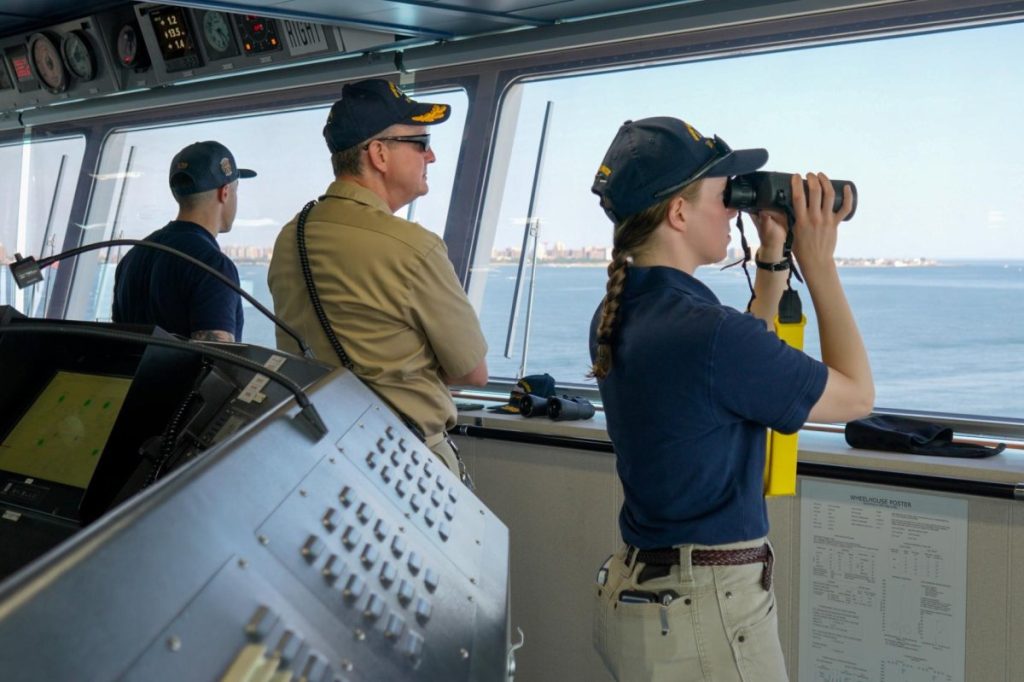
For Maine Maritime Academy, the new ship represents a dramatic leap from the wooden schooners and comparatively simple navigation instruments that once defined maritime training along the Maine coast. The State of Maine’s bridge features sophisticated navigation and communications systems, digital charts, and advanced ship-control technology designed to prepare cadets for an increasingly automated global maritime industry.
Despite the technology, the fundamentals of seamanship have changed little. Cadets must still read weather and sea conditions, work as a crew, and make decisions under pressure. Captain Gordon ‘Mac’ McArthur, a 56-year-old academy leader, emphasizes the importance of building problem-solvers and critical thinkers. ‘We start with the basics,’ he said. ‘Rowing in an eight-person lifeboat is a large part of the fall semester freshman year. We build from tying knots and turning a wrench to the more complicated things.’
The training ship’s arrival underscores the community’s enduring maritime identity, where centuries-old seafaring traditions meet the technology shaping the future of global shipping. Nowhere is that contrast more evident than at Maine Maritime Academy, where the state-of-the-art ship shares the waterfront with Bowdoin, the academy’s 1921 National Historic Landmark schooner. This living symbol of the evolution from wind-powered seamanship to the digital age of navigation serves as a classroom for learning many of the same fundamental lessons about life at sea.
The academy’s new flagship reflects Castine’s balance of maritime tradition and the future of seafaring. While Maine Maritime Academy trains the next generation of mariners for a high-tech global industry, the town is fighting to preserve the working-waterfront traditions that shaped its identity. Eaton’s Boatyard, where wooden boats have been built and repaired since 1931, remains a living workshop of Maine craftsmanship, proving that even in the digital age, some skills are still best learned by hand.
Castine’s ties to the sea run deep. Once a strategic outpost and later a bustling center of fishing, shipbuilding, and coastal trade on Penobscot Bay, the town has evolved into a quiet Downeast harbor. Maine Maritime Academy has carried its seafaring legacy into the modern era, training generations of merchant mariners and maritime professionals. The State of Maine’s Captain Craig ‘Mac’ McArthur said Castine’s centuries-old connection to the Atlantic world continues to define both the school and the town.
‘I’ve run into Maine Maritime alumni in Korea, Malaysia, Brazil, Dubai, and other places around the world,’ McArthur said. ‘Most don’t talk about their time at Maine Maritime. They talk about their time ‘in Castine.’ There is something about the remoteness of this place that prepares you for world travel.’