Death Toll Climbs to 25 in Devastating Japan Earthquake
The Kumamoto prefectural government has confirmed that a powerful earthquake that struck southwestern Japan earlier this week has now claimed at least 25 lives. The magnitude 7.1 earthquake hit the region on Tuesday, causing widespread destruction and chaos.
Rural communities in southwestern Japan were struggling to get back to normal on Thursday, two days after the disaster. Time was running out to find survivors as rescuers continued to work in the Kumamoto area on Japan’s southern main island of Kyushu.
The number of missing people remains unclear, but the Kumamoto prefectural government has confirmed 25 deaths directly related to the disaster. Nine more deaths are under investigation as likely connected to the disaster. At least 86 people were injured, with five seriously hurt, according to the prefectural government.
Survivors shared stories of desperately trying to rescue family members from the wreckage, with some suffering injuries and being rushed to the hospital. Thousands of people spent another night at evacuation centers set up throughout the area in gymnasiums and other large spaces.
Some homes were still without water or electricity, while others were simply too afraid to return. Nearly 19,000 homes were still without electricity, and over 9,000 people were staying in the roughly 400 shelters, where power sources were being added to provide air conditioning.
Concerns were growing about the risk of illness, particularly from the sweltering heat. The Ministry of Environment issued a heatstroke alert for the Kumamoto area, with temperatures expected to reach as high as 33 C (91 F) on Thursday.
In the town of Hikawa, one of the hardest-hit areas in Kumamoto, many residents were without water or electricity, or both. Some were staying inside their vehicles in parks or at the town hall parking lot. Officials delivered bottled water and packaged instant rice at the front entrance of the town hall, while the Ground Self-Defense Force service members brought a trolley to provide fresh water.
Yoshiaki Nakashima, a 66-year-old resident, came with two bottles and his beloved pet dog to get water. He was staying in a car due to his reluctance to stay at one of the three evacuation centers in the area. Nakashima also expressed his fear of sleeping at home due to aftershocks.
Akiko Inazaki, another resident in her 30s, was living in a tent set up in the yard of her home, which had been without water and electricity since the quake. Inazaki said she would use the fresh water little by little, as it was extremely valuable. She had been drinking so little that she almost had a heatstroke.
The risks of heatstroke were a major concern among officials. Yutaka Kobayashi, a doctor dispatched from central Japan’s Aichi prefecture, was touring evacuation centers to assess the condition of evacuees, especially elderly people and those with injuries.
While the town parking lot was nearly packed the first night, some residents had moved to three public schools where air conditioning was running, Hikawa officials said. A town official, Yuzuru Tamura, stated that they were starting to run out of emergency food supplies, such as canned bread and instant rice.
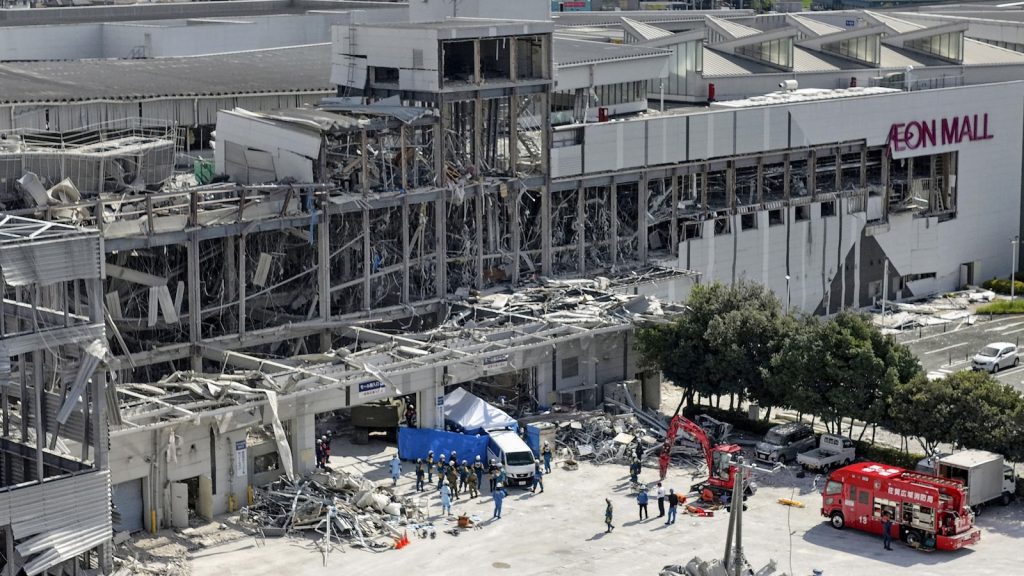
The most severe damage occurred at the Aeon Mall shopping center in the town of Kashima, where thousands of people were evacuated to a parking lot before an explosion occurred in another part of the mall. The mall’s second floor collapsed, trapping people. As of early Thursday, six people were confirmed dead at the mall site among the 11 people pulled out of the wreckage, according to Kumamoto authorities.
In the Yatsushiro area, where a chimney collapsed at a Nippon Paper Industries factory, 10 people were rescued, but eight others died, and one remained missing, according to the Kumamoto prefectural government disaster team.
Prime Minister Sanae Takaichi told reporters that the central government would take a lead role in coordinating the various rescue efforts. Restoring electricity, gas, and water to stricken areas, while providing a supply of fresh water, was key, she said.
“The needs on the ground are constantly changing. To put to rest the people’s feelings of uncertainty, we will do all that needs to be done,” she said.