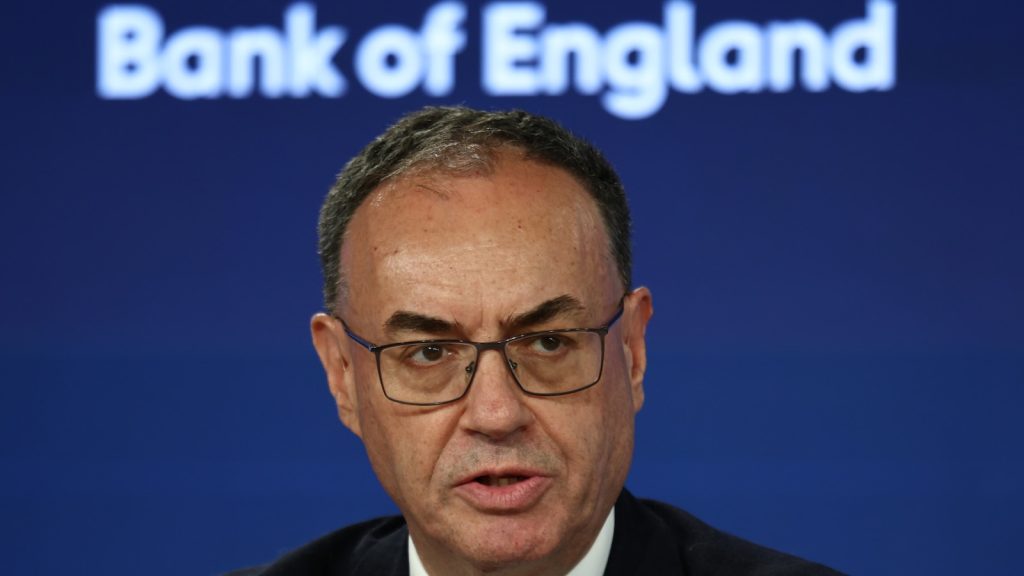
The Bank of England has made a crucial decision regarding the country’s interest rate, keeping it at 3.75% for the fifth time this year. This decision comes after a significant drop in the inflation rate last month, which has provided policymakers with some breathing space to assess the impact of the renewed fighting in Iran.
The bank’s monetary policy committee voted 6-3 to maintain the interest rate at 3.75%, aligning with the expectations of most economists. This decision follows four consecutive rate cuts in 2025, which have helped keep the rate at 3.75% since December.
The split decision highlights the growing tensions within central banks worldwide regarding how to respond to stubbornly high inflation and concerns that the war in Iran will lead to another round of price increases. The U.S. Federal Reserve, on the other hand, kept its key rate at a range of 3.5% to 3.75%, with Chairman Kevin Warsh stating that the Fed ‘will not hesitate to act’ to keep inflation under control.
The Impact of the Energy Shock on the UK Economy
The Bank of England’s monetary policy committee has emphasized the uncertainty surrounding the impact of the energy shock on the UK economy. The interest rate changes required to meet the inflation target will depend on the scale and duration of the shock, as well as how it propagates through the economy.
However, three policymakers disagreed with the committee’s decision, arguing that the potential inflationary effect of the recent surge in energy prices was too great to ignore. They voted to raise rates by a quarter point to 4%, citing concerns about the insidious second-round effects driven by catch-up dynamics in wage and price setting.
Consumer Price Inflation in the U.K.
Consumer price inflation in the U.K. slowed to 2.6% in the 12 months through June, from 2.8% the previous month, according to the latest figures from the Office for National Statistics. While the drop was larger than expected, inflation remained above the bank’s 2% target for a 21st consecutive month.
Renewed attacks by the United States and Iran in the Middle East sent oil prices soaring this month due to concerns about the continued disruption of traffic in the Strait of Hormuz, through which a fifth of all crude oil and natural gas traded once passed in peacetime.
Brent crude, the benchmark for world oil prices, jumped to more than $100 a barrel on July 23 from less than $71 three weeks earlier as the ceasefire between the U.S. and Iran broke down. Brent crude traded for about $92 a barrel on Thursday.
Central Bank Interest Rates and Inflation
Adjusting central bank interest rates, which serve as a benchmark for loans and credit cards, is the primary tool central banks use to control inflation. Higher rates make it more expensive to borrow money, tending to reduce spending and lower prices. Lower rates make it cheaper to borrow, tending to increase spending and boost prices.
Economists are also closely watching the tax and spending policies of new Prime Minister Andy Burnham to see if his efforts to shield consumers from rising prices and spur economic growth are likely to add to inflation.