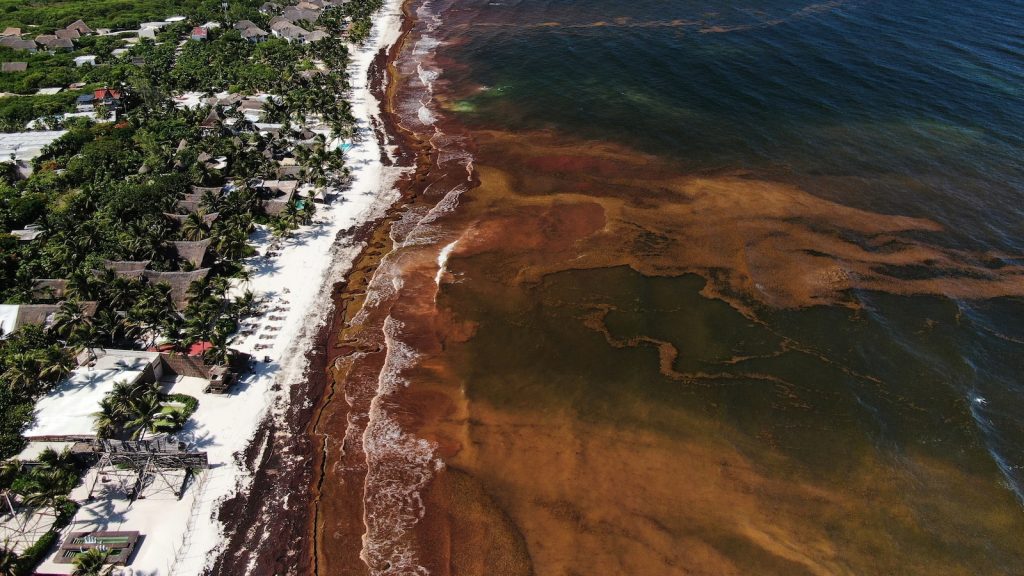
Record-Breaking Seaweed Blankets Caribbean and Gulf of Mexico Beaches
Swaths of sargassum seaweed are suffocating shorelines and snuffing out marine life in the Caribbean and Gulf of Mexico, while spooking visitors in areas that depend heavily on tourism. The issue has become a growing environmental and economic threat, with Mexico investing $115 million to tackle the blooming algae.
According to a report released by the University of South Florida’s Optical Oceanography Lab, a staggering 27 million metric tons of self-sustaining sargassum have been recorded in the Atlantic, Caribbean, and Gulf of Mexico in July. This is a significant increase from the 5 million metric tons reported in the Gulf of Mexico in June, nearly double last year’s record.
The sargassum that began reproducing in the region earlier than usual this year stems from a record 40 million metric tons reported last year. The Great Atlantic Sargassum Belt has been growing since 2011, dumping an increasing amount of seaweed along coastlines in the Caribbean and Gulf of Mexico.
Experts believe that agricultural runoff, warming waters, and changes in wind, current, and rain could be contributing factors to the growth of the sargassum. The algae usually reproduces asexually as it travels from Western Africa, but this year it has begun reproducing in the region, leading to the massive increase in seaweed.
Scientists expect 2026 to be the second-largest amount of sargassum recorded in the Atlantic, Caribbean, and Gulf of Mexico, with June alone seeing 34 million metric tons, which was only 10% lower than the year-earlier period. The coastlines are not built for this, and the effects of the sargassum on the environment and economy are severe.
The smell of rotten eggs permeates communities where large piles of decaying sargassum emit ammonia and hydrogen sulfide. The effects of these gases on people can be severe, causing nausea, headaches, and lung irritation. Officials on the French Caribbean island of Martinique recently opened a shelter to temporarily house those affected by the toxic gases after residents protested.
Crews in Martinique have collected more than 11,500 tons of sargassum, including 638 tons in four days alone this month, according to government data. Sea barriers catch some of the seaweed, while crews on shore collect the remainder by hand, storing and processing it for composting and bioenergy production.
Researchers at the University of South Florida and the U.S. National Oceanic and Atmospheric Administration used artificial intelligence to find that from 2003 to 2022, macroalgae blooms increased by more than 13% per year in the tropical Atlantic and Western Pacific. Overall, the blooms reached 16.9 million square miles (43.8 million square kilometers), according to a study published earlier this year.
The impact of the sargassum on the environment and economy is severe, with hotels and businesses in the state of Quintana Roo, one of Mexico’s tourism gems, suffering a 30% drop in sales in the first half of the year. The government estimates that up to 9,000 tons of sargassum reach the Caribbean coastline on the worst days, with current resources only able to gather 1,200 tons a day.