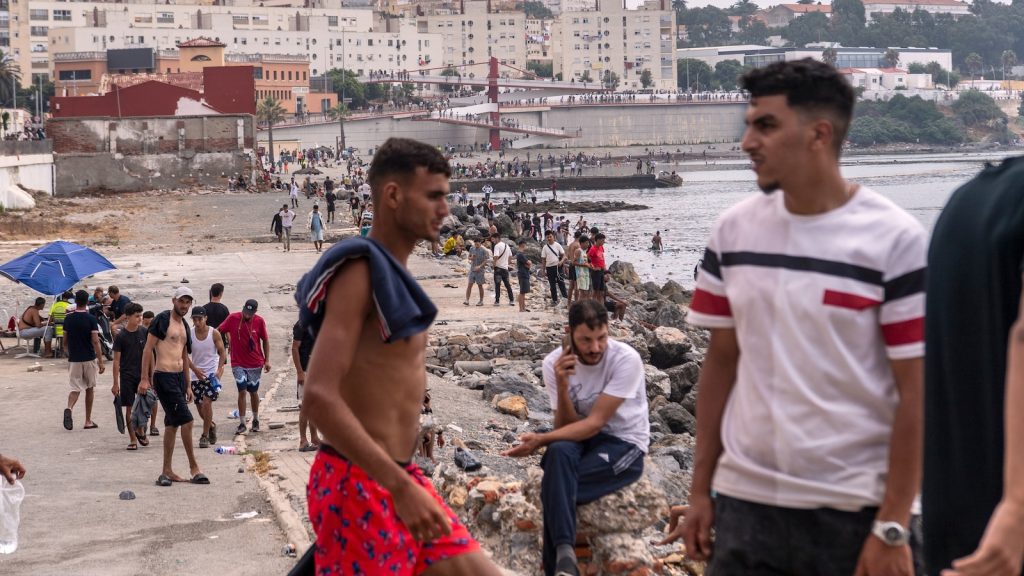
When Abdulah Buji, a 21-year-old Moroccan student, heard that the border between Morocco and Spain had been breached, he quickly jumped on his motorbike and rode as fast as he could to join the tens of thousands of other Moroccans who swam en masse to reach Spanish territory in the tiny enclave of Ceuta.
For Buji and many of his fellow countrymen, the thought of crossing into Spain was a tantalizing prospect, one that offered a chance to leave behind the poverty and lack of opportunities in Morocco and start a new life in Europe.
Desperation and Frustration
But as Buji and the new arrivals set foot on Spanish soil, their elation was quickly followed by the disheartening realization that they were still far from their ultimate goal. Mainland Europe remained across the Mediterranean, and the Spanish authorities were determined to keep them out.
Buji, who had lost his belongings and money in the crossing, was among the lucky ones who made it across alive. But he was soon to realize that he was still far from achieving his dream of a better life in Europe.
“I’ve spent perhaps 14 years studying, but there’s nothing at home, and I’d have to work 12-hour shifts for a meager wage,” Buji told The Associated Press. “That’s why I came here, but I haven’t found any opportunities here either, so I have to go back.”
A Massive Influx of Migrants
The massive influx of people, which totaled 70% of Ceuta’s resident population, sparked calls by local Spanish authorities for police and the army to establish order. The city faced a much larger humanitarian crisis this time, with thousands of mostly young men aimlessly walking the streets.
Locals were concerned by the sudden appearance of tens of thousands of migrants, many of whom were searching for lost loved ones or hoping to find a way to stay in Spain. Ikrra Khai, a 33-year-old Moroccan woman, was one of the thousands of women who regularly get temporary job permits to work on Spanish farms at harvest time.
On Friday, she was in Ceuta looking for the brother of a good friend. “I don’t know if he is dead or alive,” she said. “I have his residency card. But I don’t know where he is. I’m searching.”
Myriam Cherti, a senior researcher at the University of Oxford’s Centre on Migration, Policy and Society, said that some of the migrants she interviewed over the past year had lost count of the number of times they had tried to cross the border.
“They’re doing it out of despair, they’re doing it because they’ve tried other ways to build a life and failed, they’re doing it because they feel the obligation that they want to help their families and support them,” she said. “And that’s possible if they make it to Spain and not necessarily possible if they stay” in Morocco.
But for many of the migrants, the reality of life in Ceuta was harsh and unforgiving. Ahmed Karim, 33, was among those who managed to cross into Ceuta, but he had no work and was struggling to survive.
“The problem is compounded for many Moroccans due to the difficulty in traveling outside the country,” he said. “Many Moroccans want to go to Europe or America, but they don’t have the opportunity.”
A Humanitarian Crisis
The massive influx of people sparked a humanitarian crisis in Ceuta, with thousands of migrants left to fend for themselves on the streets. The city was overwhelmed, with many residents calling for the authorities to establish order and provide assistance to the migrants.
Train stations in Morocco’s capital, Rabat, and in the country’s largest city, Casablanca, were crowded with people trying to travel to the border with Ceuta. Local media showed police officers preventing some of them from boarding trains and buses.
It isn’t clear what triggered the influx, but social media was awash with posts encouraging Moroccans to try to enter Ceuta days before it began, said Cherti. The posts included practical information on how to cross the border and what migrants should say to increase their chances of being allowed to stay.
As the situation in Ceuta continues to unfold, it remains to be seen whether the migrants will find a way to achieve their dream of a better life in Europe or whether they will be forced to return to Morocco, with their hopes and dreams shattered.
One thing is certain, however: the situation in Ceuta is a humanitarian crisis that requires urgent attention and assistance.
A Complex Issue
The situation in Ceuta is complex and multifaceted, involving issues of migration, poverty, and lack of opportunities in Morocco. It is an issue that requires a nuanced and multifaceted approach, one that takes into account the needs and aspirations of both the migrants and the local population.
As the situation in Ceuta continues to unfold, it is essential that we approach this issue with empathy, compassion, and a commitment to finding a solution that works for everyone involved.
Only then can we hope to find a way to address the root causes of the migration crisis and provide a better future for the thousands of Moroccans who are seeking a better life in Spain.