Europe’s Wildfire Crisis Shifts as Thousands Return Home, New Blazes Force Thousands to Flee
Firefighters have contained a vast wildfire in southwestern France, allowing nearly 200,000 people to return home after what may have been the country’s largest peacetime evacuation. This remarkable feat of firefighting came as a new wave of wildfires forced thousands to flee their homes in France and Greece.
In the Mediterranean Var, a fire thought to have stopped advancing suddenly spread across 10 square kilometers in just six hours on Friday, leaving authorities stunned. ‘Faster than a horse at full gallop,’ the prefecture described the speed at which the fire moved. This sudden and unexpected movement underscored how quickly the hard-won gains of firefighting progress can be reversed.
The opposing movements – mass returns in France’s Gironde region, renewed displacement in the Var, and boat evacuations from a Greek resort – highlighted the fluid and unpredictable nature of the ongoing wildfire crisis. At their peak, fires in France and Spain alone drove some 330,000 people from their homes and vacation sites, stretching firefighters, aircraft, and emergency services to their limits.
Europe is the Earth’s fastest-warming continent, with temperatures rising at more than twice the global average since the 1980s, according to the European Union’s Copernicus climate service. Rising temperatures and prolonged drought dry out vegetation, allowing fires to spread faster and burn more intensely.
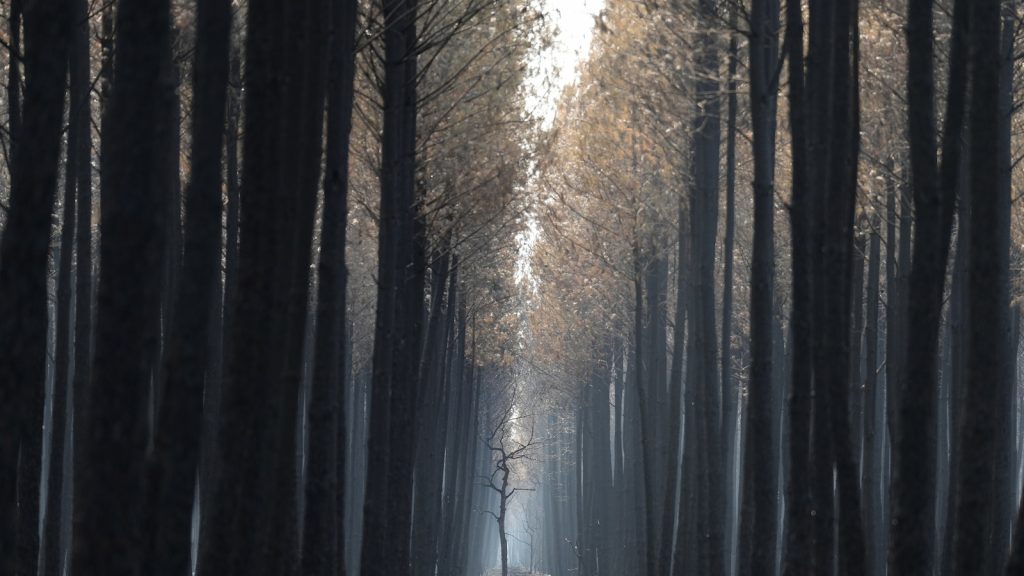
The Gironde fire has consumed 420 square kilometers of pine forest west of Bordeaux, an area four times the size of Paris. Firefighters said it remained contained within that perimeter on Saturday, with flames not breaking beyond its existing boundaries. However, the fire had not been declared ‘fixed,’ and active sectors and buried hotspots persisted.
‘Today, the fire is still not fixed. It is contained,’ Lt. Col. Eric Pitault told reporters. Crews used tactical burns overnight, deliberately consuming vegetation ahead of active sectors to deprive the main fire of fuel. They still faced about 240 kilometers of fire edges where heat can remain buried underground and erupt again.
The fire’s toll extended beyond people and property. Allain Bougrain-Dubourg, president of France’s League for the Protection of Birds, told RMC radio that animals affected already numbered in the millions. In the Var, a fire declared fixed earlier in the week suddenly flared back across the hills within hours on Friday, defying understanding.
Authorities kept the affluent, forested Cap Ferret peninsula mostly empty because a nearby hot spot could flare again, threatening its limited road access and trapping residents and tourists. ‘The fire is still not fixed. It is contained,’ Lt. Col. Eric Pitault emphasized.
Twenty French departments were under an orange heat warning on Saturday, mostly in the east and southeast. Temperatures of 35 to 39 C (95 to 102 F) were forecast around the Mediterranean, while eight departments faced a high forest-fire risk. In Greece, hundreds of firefighters fought to protect Porto Germeno, a popular resort on the Gulf of Corinth, as gale-force winds drove flames through the coastal area between Athens and Thebes.
The fire broke out near the neighboring village of Agios Vasileios. About 300 people were evacuated by sea, and authorities issued several further evacuation orders on Saturday. The damage around Porto Germeno was ‘inconceivable,’ Theodore Giannaros, a wildfire meteorologist at the National Observatory of Athens, wrote on Facebook.
Giannaros estimated that 40 to 50 square kilometers had been affected, although authorities had not issued an official burned-area figure. Reinforcements brought the deployment to 420 firefighters, including 20 specialized forest-fire teams, backed by 19 aircraft and 11 helicopters. Local authorities said homes had been destroyed, but a complete count was not immediately available.