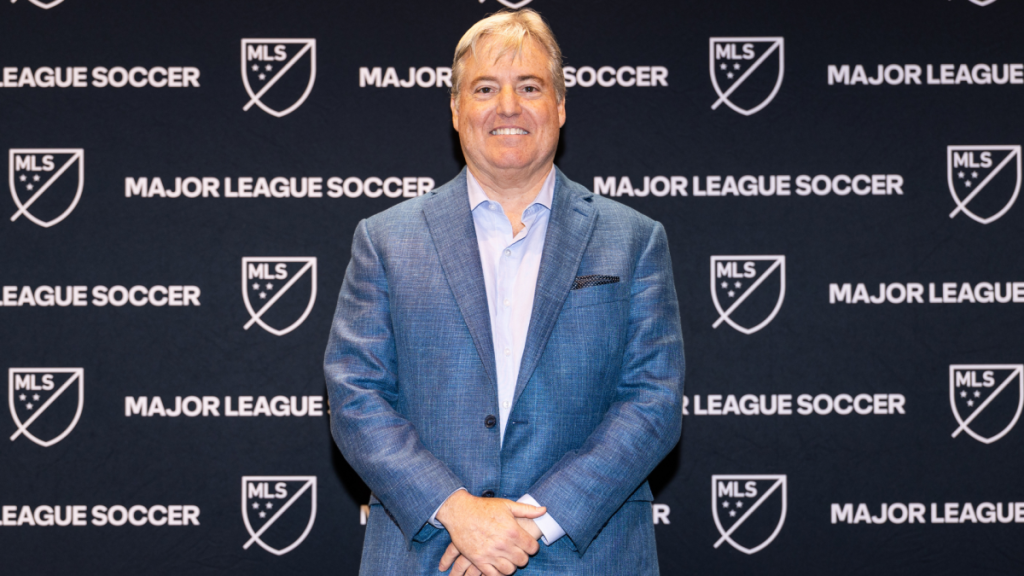
MLS Enters a New Era Under Larry Berg
Don Garber and Larry Berg may have been unveiled as the incoming MLS commissioner on the same day, but the 27 years in between their announcements highlight the significant strides the league has made since Garber’s tenure began in 1999.
The league has come a long way from its early days, solving questions about financial viability and boasting a healthy number of supporters in the U.S. before this summer’s World Cup. Layers of infrastructure are in place, with Garber calling lifelong soccer fan Berg a ‘byproduct’ of the decades of investment that transformed American soccer from a fractured, malnourished ecosystem to a fully professional operation.
However, the league faces a relevancy problem, feeling cloistered away from the most notable American sports leagues and amongst global soccer leagues. Despite the strides it has made, MLS is yet to break through fully in either sense.
Larry Berg’s Vision for the League
Larry Berg, a private equity professional and co-owner of LAFC, outlined the bare bones of his plan to address these questions on Tuesday. His pitch is built around quality of play and building consensus amongst the ownership groups who employed him.
‘Simply put, the foundation has been built,’ Berg noted. ‘Now it’s our responsibility to build on it and that’s what excites me most. I didn’t accept this role to protect what we’ve already accomplished. I accepted it because I believe this league is ready for its next chapter.’
Berg emphasized the importance of quality on the field, arguing that it is the key to unlocking the league’s relevance issue. He believes that this can be achieved by investing in the roster, which will lead to more transfer revenue and media money. This, in turn, will result in a better product on the field, creating a ‘flywheel’ effect that will lead to more transfers, revenue, and media money.
Berg also highlighted the need for youth development, stating that he feels like the league has the ‘clay’ to build upon. He emphasized the importance of getting more players more minutes at a younger age, playing at the highest level, and continuing to feed the national teams.
‘Youth development in MLS is very near and dear to my heart,’ Berg said. ‘I feel like we have the clay, we’ve built the foundation. Almost every team has an academy. Most teams have an MLS Next Pro team. Every year, we have more and more emerging stars that are coming through.’
Format Changes, Broadcast Partners on the Agenda
Berg will assume the helm of the league months before it undergoes a flip to the fall to spring calendar, a necessary move to ensure the league’s business runs concurrently with the majority of global soccer leagues. This may also provide the opening for a new competition format, both in terms of how the regular season and playoffs operate.
‘I think the new calendar was a massive move,’ Berg said. ‘I think the new playoffs, the new divisions, these are all really important.’
However, what exactly that new format is, is to be determined. Berg emphasized the importance of achieving consensus and moving forward together, stating that the good news is that the things they are thinking about will move the league forward, make it entertaining, and make it interesting.
‘I don’t know, timing-wise, when that might be,’ Berg said. ‘We obviously have, next summer, the start of our new calendar, so that’s a pretty big deal. Perhaps we have it by then, I hope, but it’s really about what the owners can do and what kind of analysis and leadership I can provide as a part of that.’
Ultimately, Berg’s vision for the league is centered around quality of play, youth development, and building consensus amongst the ownership groups. He believes that by investing in the roster and developing young players, the league can unlock its relevance issue and become a more competitive force in the world of soccer.