German Food: A Hearty and Diverse Culinary Experience
German cuisine is renowned for its rich flavors, hearty portions, and high-quality ingredients. From traditional dishes to modern twists, German food has evolved over the centuries, influenced by the country’s agricultural traditions and the many immigrants who have made Germany their home.

Source: media.cnn.com
Today, Germans appreciate well-prepared meals as much as they do a quick bite on the go. This is a country of food markets, beer gardens, wine festivals, food museums, and high-end restaurants.

Source: media.cnn.com
Königsberger Klopse: A Beloved Dish with a Complicated History
Named after the former East Prussian capital of Königsberg, this tasty dish of meatballs in a creamy white sauce with capers is a beloved favorite among grandmothers and chefs alike. The meatballs are traditionally made with minced veal, onion, eggs, anchovies, pepper, and other spices, while the sauce’s capers and lemon juice give this filling comfort food a surprisingly elegant finish.

Source: media.cnn.com
In the German Democratic Republic, officials renamed the dish kochklopse (boiled meatballs) to avoid any reference to its namesake, which had been annexed by the Soviet Union. Today, it’s possible to find königsberger klopse under their traditional name in most German restaurants, but they are especially popular in Berlin and Brandenburg.
Maultaschen: A Traditional Dish from Swabia
Maultaschen from Swabia are a lot like ravioli but bigger. They are typically palm-sized, square pockets of dough with fillings that run the gamut from savory to sweet and meaty to vegetarian. A traditional combination is minced meat, bread crumbs, onions, and spinach – all seasoned with salt, pepper, and parsley.
They’re often simmered and served with broth instead of sauce for a tender, creamier treat, but are sometimes pan-fried and buttered for extra richness. Today, you can find maultaschen all over Germany (even frozen in supermarkets) but they’re most common in the south.
Labskaus: A Delicious Mess from Northern Germany
Labskaus is not the most visually appealing dish, but a delectable mess that represents the seafaring traditions of northern Germany like no other. In the 18th and 19th centuries, ship provisions were mostly preserved fare, and the pink slop of labskaus was a delicious way of preparing them.
Salted beef, onions, potatoes, and pickled beetroot are all mashed up like porridge and served with pickled gherkins and rollmops. It has long been a favorite of Baltic and North Sea sailors.
Bratwurst: The King of German Sausages
There is no Germany without sausages. There are countless cured, smoked, and other varieties available across wurst-loving Germany, so, for this list, we will focus on some of the best German street food: bratwurst, or fried sausages.
Fried on a barbecue or in the pan, and then served in a white bread roll with mustard on the go, or with potato salad or sauerkraut as the perfect accompaniment for German beer. Some of the most common bratwurst are:
- Fränkische bratwurst from Fraconia with marjoram as a characteristic ingredient.
- Nürnberger rostbratwurst that is small in size and mostly comes from the grill.
- Thüringer rostbratwurst from Thuringia, which is quite spicy.
Currywurst: A German Street Food Classic
Practically synonymous with German cuisine since 1945, currywurst is commonly attributed to Herta Heuwer, a Berlin woman who in 1949 managed to obtain ketchup and curry powder from British soldiers, mixed them up, and served the result over grilled sausage, instantly creating a German street food classic.
Today, boiled and fried sausages are used, and currywurst remains one of the most popular sausage-based street foods in Germany, especially in Berlin, Cologne, and the Rhine-Ruhr, where it’s usually served with chips and ketchup or mayonnaise or a bread roll.
Not the most sophisticated of dishes, but a filling street snack born out of necessity about which all of Germany is still mad: some 800 million are consumed a year.
Döner Kebab: A Turkish-Inspired German Favorite
Döner kebab was introduced to Germany by Turkish immigrant workers coming here in the 1960s and ’70s. One of the earliest street sellers was Kadir Nurman, who started offering döner kebab sandwiches at West Berlin’s Zoo Station in 1972, from where the dish first took both West and East Berlin by storm and then the rest of Germany.
From its humble Berlin beginnings when a döner kebab only contained meat, onions, and a bit of salad, it developed into a dish with abundant salad, vegetables (sometimes grilled), and a selection of sauces from which to choose.
Veal and chicken spits are widely used as is the ever-popular lamb, while vegetarian and vegan versions are becoming increasingly common.
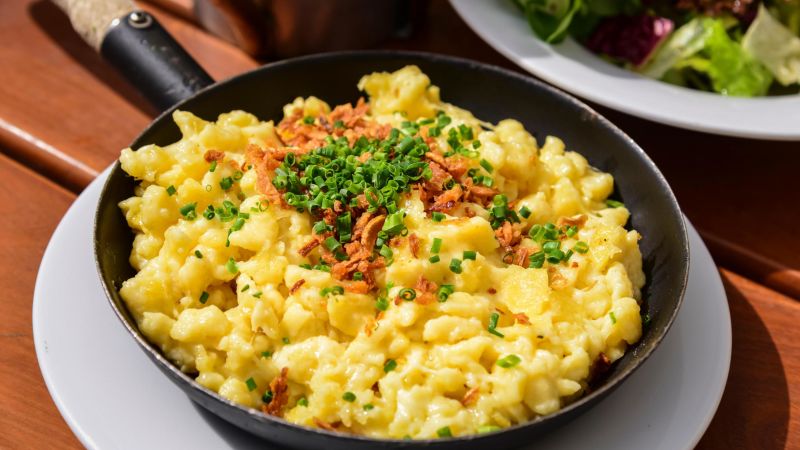
Käsespätzle: A Popular Dish from Southern Germany
Spätzle originally come from Baden-Württemberg. Essentially a sort of pasta, the noodles are a simple combination of eggs, flour, salt, and often a splash of fizzy water to fluff up the dough. Traditionally served as a side to meat dishes or dropped into soups, it can be spiced up by adding cheese: the käsespätzle variant is an extremely popular dish in southern Germany, especially Swabia, Bavaria, and the Allgäu region.
Hot spätzle and grated granular cheese are layered alternately and are finally decorated with fried onions. After adding each layer, the käsespätzle will be put into the oven to avoid cooling off and to ensure melting of cheese.
Rouladen: A Delicious Blend of Bacon, Onions, and Pickles
Rouladen is a delicious blend of bacon, onions, mustard, and pickles wrapped together in sliced beef or veal. Vegetarian and other meat options are also now widely available, but the real deal is rinderrouladen (beef rouladen), a popular dish in western Germany and the Rhine region.
This is a staple of family dinners and special occasions. They are usually served with potato dumplings, mashed potatoes, and pickled red cabbage. A red wine gravy is an absolute requirement to round off the dish.
Sauerbraten: A National Dish of Germany
Sauerbraten is regarded as one Germany’s national dishes and there are several regional variations in Franconia, Thuringia, Rhineland, Saarland, Silesia, and Swabia.
This pot roast takes quite a while to prepare, but the results, often served as Sunday family dinner, are truly worth the work. Sauerbraten (literally ‘sour roast’) is traditionally prepared with horse meat, but these days beef and venison are increasingly used.
Before cooking, the meat is marinated for several days in a mixture of vinegar, water, and spices. The result is a tender, flavorful dish that is a staple of German cuisine.