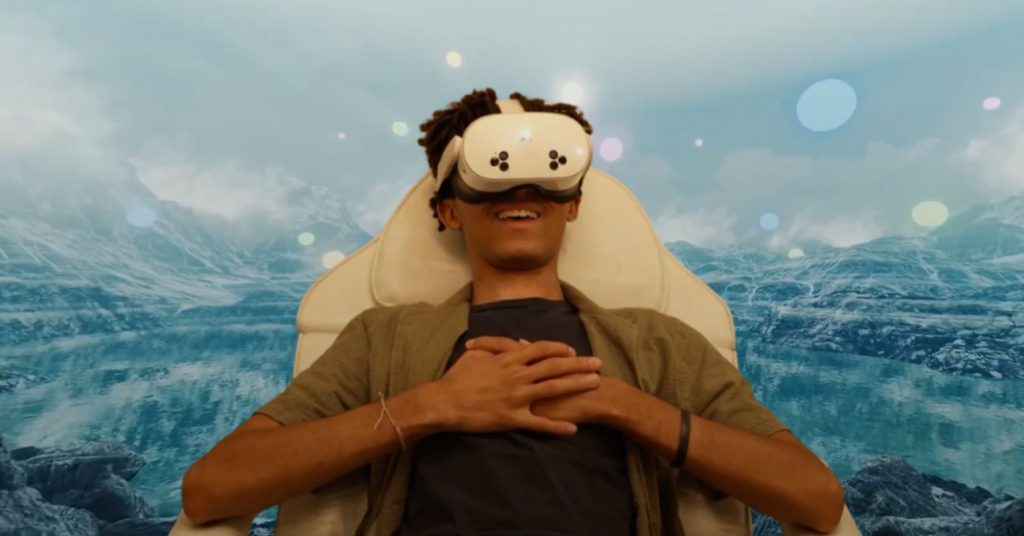
Shifting the Nervous System in Real-Time with Immersive Biofeedback
Immersive biofeedback is a new category of digital tools that combines real-time monitoring of physiological data with virtual reality environments. This innovative approach has been gaining attention for its potential in reducing anxiety and heart rate, but what exactly is immersive biofeedback, and how does it work?
According to Tyler Woods, an expert in the field, the problem with traditional stress-reduction practices like meditation and breathwork is that they are blind. Users have no way of knowing if they are doing it correctly, and without any feedback, they may give up before seeing the full benefits.
The approach that Woods wants to explore sits at the intersection of two well-established approaches: biofeedback and immersive technologies, such as virtual reality (VR). Biofeedback involves measuring a physiological signal, such as heart rate, respiration, skin conductance, or brainwave activity, and displaying it back to the person in real-time. The core insight behind biofeedback is that you can learn to regulate any physiological process if you can see what is happening.
Immersive biofeedback pairs real-time physiological monitoring with a virtual environment that responds to the user’s data. This means that the user’s own biometric signals drive what they see. For example, if they slow their breathing, the virtual world responds accordingly. This closed-loop system allows users to directly experience their physiology and learn to regulate it in a more intuitive way.
Research has shown that immersive biofeedback may specifically address three persistent challenges in traditional biofeedback: motivation, attentional focus, and transferring learned skills into daily life. A recent meta-analysis of neurofeedback effectiveness found that more complex, richer feedback produced the strongest effects. Immersion may be exactly what that finding is pointing toward.
The research base for immersive biofeedback is still young, but it is growing, and the early results are encouraging. A systematic review and meta-analysis of VR biofeedback interventions found significant reductions in self-reported anxiety and heart rate compared to control conditions. A more recent randomized controlled study reported reductions in both depressive and anxiety symptoms following VR-based biofeedback.
Immersive biofeedback is not a meditation app, nor is it traditional clinical biofeedback, which measures signals but displays them on a flat monitor as numerical data or simple animations. It is also not passive VR relaxation, where the environment is beautiful but completely indifferent to what the user’s nervous system is doing. Immersive biofeedback closes the loop between all three, seeing the user and reflecting this information inside an environment that their senses actually believe.
In conclusion, immersive biofeedback is a promising new category of digital tools that combines real-time monitoring of physiological data with virtual reality environments. By providing users with direct feedback and a more intuitive way to learn and regulate their physiology, immersive biofeedback may be the solution to the persistent challenges in traditional biofeedback.