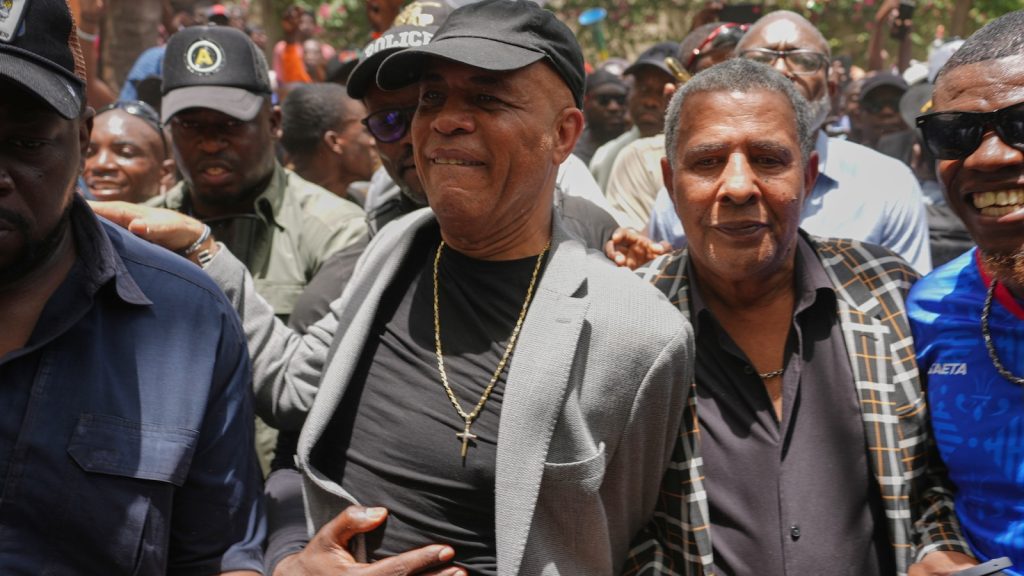
Former Haitian President Michel Martelly Returns to Haiti Amid Ongoing Investigation
PORT-AU-PRINCE, Haiti — Former Haitian President Michel Martelly has made a rare visit to his homeland, touching down in Haiti on Wednesday amidst an ongoing investigation into the 2021 assassination of former President Jovenel Moïse.
Martelly, who served as president from 2011 to 2016 and currently resides in the United States, was met with a crowd of several dozen supporters upon his arrival. The supporters, who were largely enthusiastic and jubilant, waved flags, played music, and held up pictures of the former president as they chanted slogans such as ‘The father is back!’ and ‘Long live Martelly!’
However, Martelly himself did not answer questions as he made his way through the crowd, opting instead to maintain a dignified silence. The reason behind his visit remains unclear, although local media have reported that he is expected to testify in connection with the ongoing investigation into Moïse’s killing.
It is worth noting that Martelly has not been accused or charged in connection with the case, which last led him to visit Haiti roughly three years ago. Nevertheless, his return to Haiti comes as the country continues to grapple with the aftermath of Moïse’s assassination, which has left a power vacuum and deepened the country’s ongoing humanitarian crisis.
Martelly’s return to Haiti also coincides with a period of significant turmoil in the country’s politics. The Tèt Kale Party, to which both Martelly and Moïse belonged, has played a prominent role in Haitian politics but has not registered a candidate for the upcoming general elections, which have not been held for over a decade.
In addition to the ongoing investigation into Moïse’s killing, Martelly has also faced a number of other challenges in recent years. In November 2022, Canada sanctioned Martelly, accusing him of facilitating drug trafficking and sponsoring multiple gangs. The United States followed suit in August 2024, also accusing Martelly of facilitating drug trafficking and sponsoring gangs.
The U.S. Department of State issued a statement at the time, saying ‘It is unacceptable for Haitian political and economic elites to plunder Haiti’s future.’ The statement was a clear indication of the U.S. government’s growing concern over Martelly’s activities and its desire to see him held accountable for his actions.
Furthermore, the Council of the European Union announced a travel ban and an asset freeze against Haitian politicians, including Martelly, in December 2025. The council accused Martelly of arming and financing gangs to promote his political agenda, control territory, and defend his personal and economic interests.
Haiti’s Anti-Corruption Unit has also accused Martelly of misrepresenting assets, although he has not publicly addressed these allegations. The unit’s accusations are a further indication of the depth of corruption that has plagued Haiti’s politics in recent years.
As Martelly’s return to Haiti has sparked a mix of emotions among the country’s citizens, many are left wondering what the future holds for the former president and the country he once led. Will he be able to clear his name and restore his reputation, or will the ongoing investigation into Moïse’s killing ultimately prove to be his undoing? Only time will tell.