SpaceX Scrubs Launch of 13th Test Flight for Massive Starship Rocket
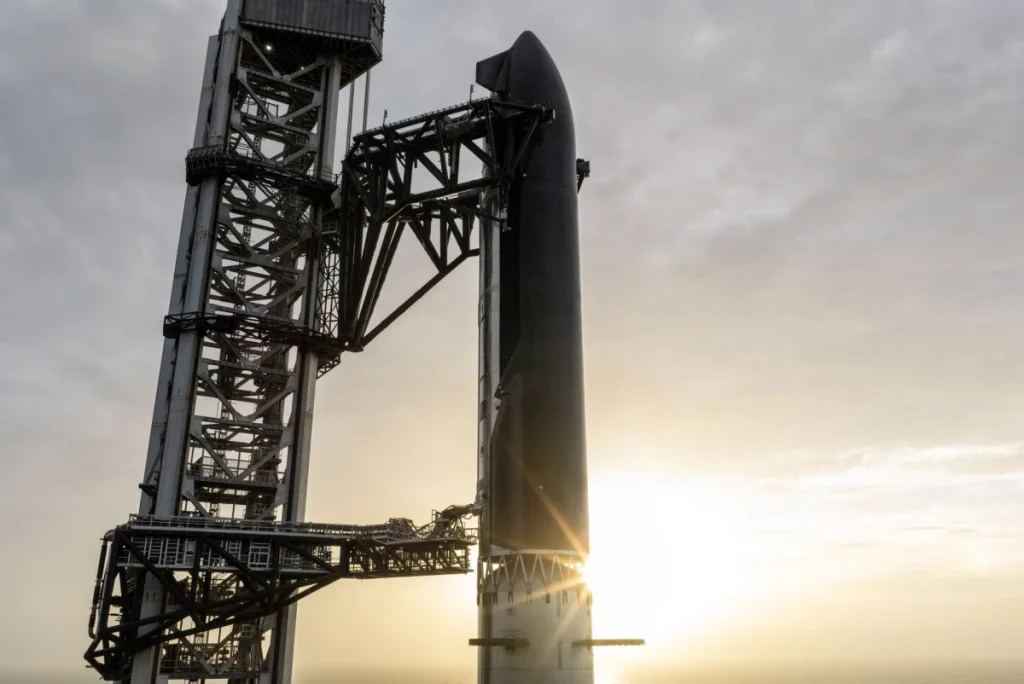
On Thursday, SpaceX scrubbed the planned 13th test flight of its massive Starship megarocket just seconds before it was set to lift off from the company’s Texas Starbase. The launch was abruptly canceled just before the ‘Super Heavy’ booster was about to ignite its multiple engines.
Source: cdnph.upi.com
‘Standing down from today’s flight test attempt,’ launch commanders posted on X, without immediately offering a further explanation. It remained unclear when another launch would be scheduled.
In the build-up to the planned launch, the company said it is aiming to fine-tune the performance of the third version of the most powerful rocket ever built with Thursday’s mission – specifically the Super Heavy booster. The Starship system has two parts: the Super Heavy booster and the spacecraft itself, also called Starship, or sometimes just ‘Ship.’
During the 12th test flight on May 22, the Starship system encountered several hiccups, including slight differences in engine startup at separation stage causing the directional flip of the booster to be off by approximately 90 degrees. The booster was supposed to perform a sustained burn to a controlled landing in the gulf, but the engine failure meant it fell back to Earth instead in a ‘hard splashdown,’ SpaceX said in its launch report.
The Federal Aviation Administration said there were no reports of public injury or damage to public property from the mishap. In response, SpaceX said in a blog post that ‘the startup sequence has been modified to be more robust to timing variability and more reliably flip in the desired direction, which is done to increase overall performance.’
Also during Flight 12, the Super Heavy booster encountered problems when attempting its boostback burn in which five of its 33 engines malfunctioned when attempting to re-light. This caused the boostback burn to end early.
‘The Super Heavy on this upcoming flight has hardware modifications to improve re-light reliability along with updates to engine alarms and aborts to match the conditions seen in the multi-engine flight environment,’ SpaceX said.
One of the notable elements of Thursday’s Flight 13 was that Starship for the first time will carry V3 Starlink satellites to space as the company aims to ‘greatly expand’ its communications network’s capacity and user speeds. As part of this initial test, Starship is set to deploy 20 satellites which will extend solar arrays and antennas in a bid to connect with the larger Starlink constellation via high-capacity lasers as they will be on the same suborbital trajectory as Starship.
Those satellites are designed to burn up on reentry into the Earth’s atmosphere approximately 20 minutes after deployment. SpaceX launches Starlink satellites to provide fast and reliable internet connectivity to remote areas of the world.
SpaceX is working towards its ambitious goal of establishing a permanent human presence on the lunar surface with its Starship system. Plans call for Starship to carry Artemis 4 astronauts to the surface of the moon in a mission set for late 2028. The Starship system has been designed to be reusable, which will greatly reduce the cost of space travel and make it more accessible to people around the world.
In the coming months, SpaceX is expected to continue testing the capabilities of its Starship system. The company has already made significant progress in the development of its reusable rockets, and it is likely that the Starship system will play a major role in the future of space travel.
SpaceX has been working tirelessly to develop its Starship system, and it has made significant progress in recent months. The company is now on the cusp of a major breakthrough in space travel, and it is expected that the Starship system will play a major role in the future of space exploration.
The Starship system is a major step forward in the development of reusable rockets. It has the potential to greatly reduce the cost of space travel and make it more accessible to people around the world.