Market Volatility Grips Seoul Amid Global Economic Concerns
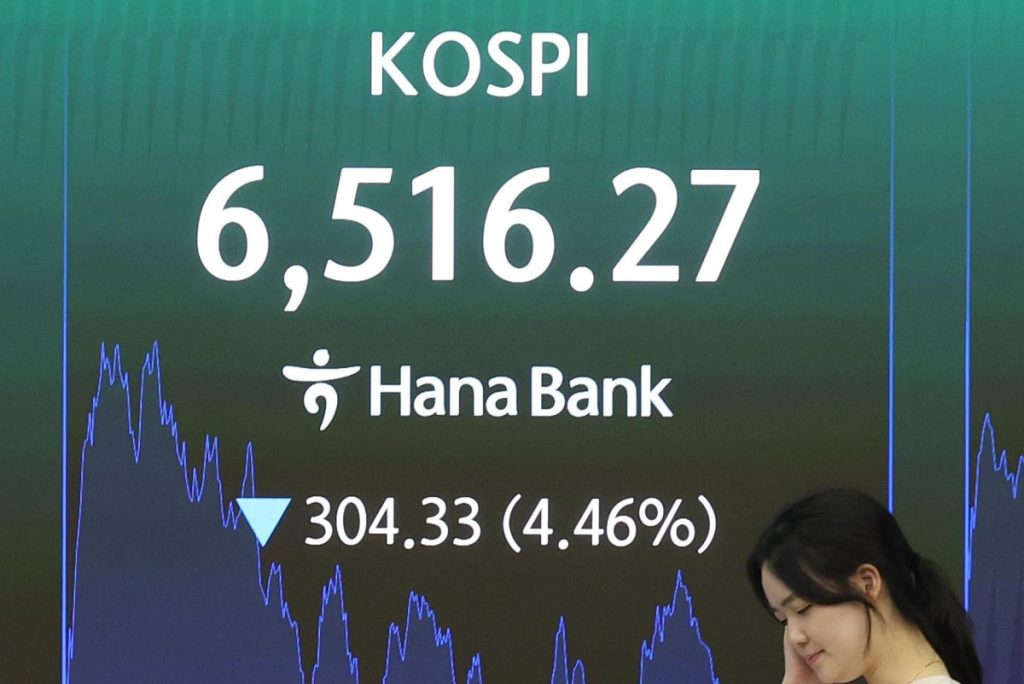
The South Korean stock market experienced a significant downturn, with the benchmark Korea Composite Stock Price Index (KOSPI) plummeting 304.33 points, or 4.46 percent, to 6,516.27 points. This decline marks a substantial drop in the market’s value, with trade volume reaching 339.5 million shares worth 28.4 trillion won (US$19.2 billion). The Korean won, on the other hand, rose against the U.S. dollar, closing at 1,478.4 won.
The decline in the KOSPI was largely attributed to the resurgence of concerns over artificial intelligence (AI) and the escalating tensions in the Middle East. The latest AI model unveiled by Chinese startup Moonshot, known as Kimi K3, has raised fears about the massive capital spending from hyperscalers. This model is considered to deliver performance approaching the most advanced AI models from the U.S. at a significantly lower cost, sparking speculation about the justification of such investments.
Analysts point to the worsening conflict risks between the United States and Iran as another factor contributing to the market’s decline. The U.S. military’s announcement of a third U.S. soldier’s death in Iraq during back-and-forth attacks between the U.S. and Iran has heightened tensions in the region, further dampening investor sentiment.
The tech sector was particularly hard hit, with most shares closing lower. Samsung Electronics, the market’s top-cap stock, dipped 4.31 percent to 244,000 won, while its rival SK hynix shed 4.23 percent to 1,764,000 won. AI infrastructure-related shares also lost ground, with LS Electric losing 5.63 percent to 179,300 won and Hyosung Heavy Industries Corp. falling 8.96 percent to 2,539,000 won.
On the other hand, a few stocks managed to buck the trend, with Shipper HMM inched up 0.1 percent to 20,150 won and refiner S-Oil adding 1.24 percent to 146,700 won.
The Korean won’s appreciation against the U.S. dollar is a notable exception in an otherwise gloomy market. The won’s strength is likely to have a positive impact on the country’s exports, which could help to mitigate the effects of the market’s decline.
Bond prices also closed lower, with the yield on three-year Treasurys adding 4.7 basis points to 3.895 percent and the return on the benchmark five-year government bonds rising 5.5 basis points at 4.154 percent.
Institutional investors were net sellers, offloading 919.1 billion won, while foreigners and retail investors snapped up a combined net 864.4 billion won. This contrast highlights the complexities of the market and the various factors at play.
As the market continues to navigate these challenging conditions, investors and analysts will be closely watching the developments in the tech sector and the global economic landscape.
Lee Kyoung-min, an analyst at Daishin Securities, offered some insight into the market’s performance, stating, ‘Unfavorable factors related to semiconductors and worsening conflict risks between the United States and Iran dampened investor sentiment.’
As the market grapples with these challenges, it remains to be seen how the situation will unfold and what impact it will have on the global economy.
In conclusion, the Seoul stock market’s decline is a complex issue, influenced by a multitude of factors, including AI fears and Middle East tensions. The market’s performance will continue to be closely watched as investors and analysts navigate these challenging conditions.
Bullet points summarizing the key points:
- The KOSPI plummeted 304.33 points, or 4.46 percent, to 6,516.27 points.
- The tech sector was hard hit, with most shares closing lower.
- AI infrastructure-related shares lost ground, with LS Electric losing 5.63 percent to 179,300 won and Hyosung Heavy Industries Corp. falling 8.96 percent to 2,539,000 won.
- Shipper HMM inched up 0.1 percent to 20,150 won, and refiner S-Oil added 1.24 percent to 146,700 won.
- The Korean won rose against the U.S. dollar, closing at 1,478.4 won.
- Bond prices closed lower, with the yield on three-year Treasurys adding 4.7 basis points to 3.895 percent and the return on the benchmark five-year government bonds rising 5.5 basis points at 4.154 percent.