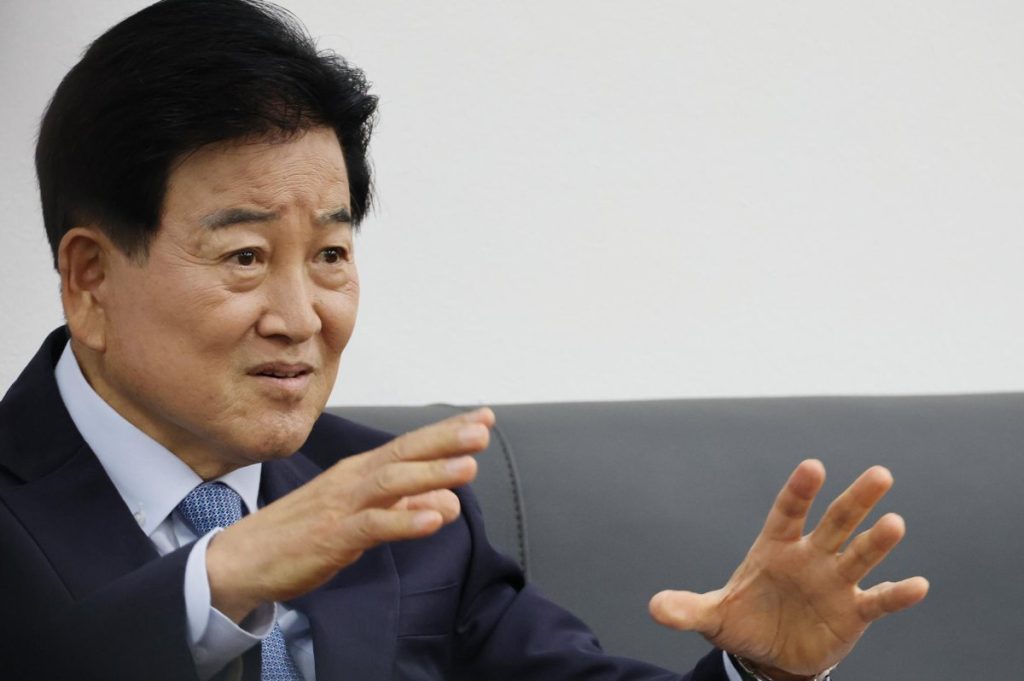
Unification Minister Chung Dong-young announced a significant shift in South Korea’s policy on North Korea, moving away from a focus on denuclearization to a peace-first approach. This change in stance comes as North Korea continues to advance its nuclear program, despite efforts from the international community to halt its progress.
Background on the Shift in Policy
Minister Chung made this announcement during a press briefing marking his one year in office, which began on July 25, 2025. He stated that the government has effectively abolished the previous government’s stance centered on achieving denuclearization first, also known as the Complete, Verifiable, and Irreversible Denuclearization (CVID) policy. In its place, the government is adopting a peace-first policy, which prioritizes dialogue and cooperation with North Korea.
Chung explained that this shift in policy is in response to North Korea’s continued development of its nuclear program, despite the international community’s efforts to engage in dialogue. He noted that the North continues to advance its nuclear program, even in the face of increasing pressure from the international community.
The peace-first policy aims to create a more favorable environment for resuming stalled talks with North Korea. The government is working to develop a strategy that would offer reciprocal benefits to North Korea if it halts the production of new nuclear arsenals. However, it remains to be seen whether this new approach will yield any positive results, given North Korea’s lack of interest in dialogue with South Korea.
North Korea’s stance on its nuclear program has not changed, despite the efforts of the international community. The country continues to reiterate its commitment to expanding its nuclear forces, and has shown little interest in dialogue with South Korea. The international community, including the United States and China, has also abandoned their longstanding policy focused on North Korea’s denuclearization, further emphasizing the need for a new approach.
The Lee Jae Myung government has been trying to engage in reconciliatory gestures with North Korea, but these efforts have been met with little response. North Korea has instead doubled down on its nuclear and missile programs, and has sought to have its status as a nuclear state recognized by other world powers, particularly China and Russia.
Chung emphasized that the government sees no reason to delay in adopting a peace-first policy, given North Korea’s continued advancement of its nuclear program. He noted that the United States and China have also abandoned their longstanding policy focused on North Korea’s denuclearization, further emphasizing the need for a new approach.
Implications of the Shift in Policy
The shift in policy from denuclearization to a peace-first approach has significant implications for the international community and North Korea. It remains to be seen whether this new approach will yield any positive results, given North Korea’s lack of interest in dialogue with South Korea.
The peace-first policy aims to create a more favorable environment for resuming stalled talks with North Korea. However, it is unclear whether this new approach will be successful, given North Korea’s continued development of its nuclear program.
The implications of this shift in policy are far-reaching and will likely have a significant impact on the international community’s approach to North Korea. It remains to be seen whether this new approach will yield any positive results, and whether it will be successful in achieving its goals.