Whale ‘Supergroups’ Rebound in Southern Hemisphere
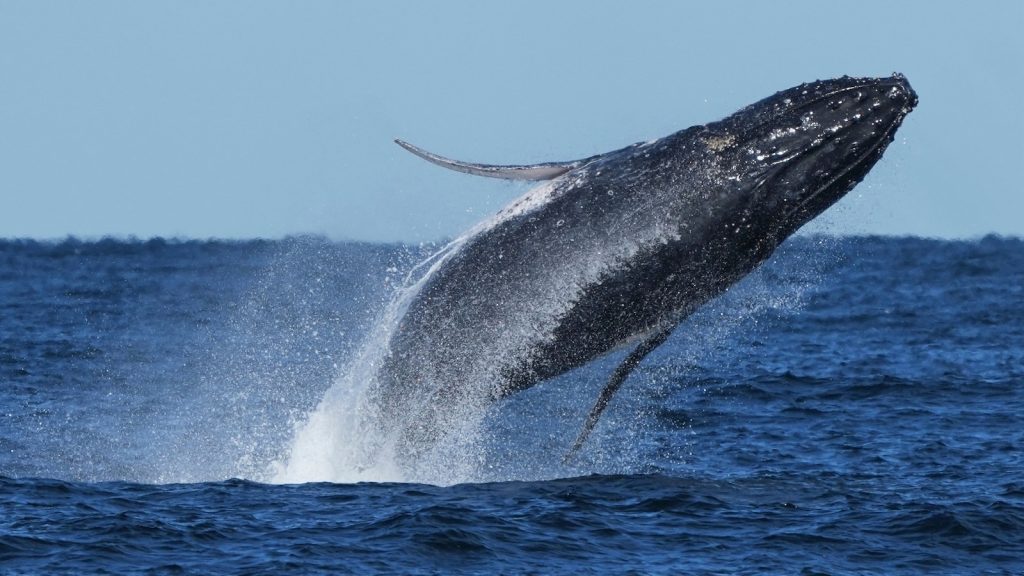
A recent sighting of nearly 300 humpback whales gathering together off the coast of South Africa has provided a heartening indication of the rebounding numbers of some whale species in the southern hemisphere. This phenomenon, known as a ‘whale supergroup,’ is a rare and extraordinary event that has been documented by renowned wildlife photographer Chris Fallows and his wife Monique.
According to Fallows, who has spent 35 years documenting marine animals, the supergroup was an unforgettable experience. ‘It was extraordinary,’ he said. ‘Quite quickly we realized that there must be several hundred whales coming together in one particular area.’ The couple’s boat was surrounded by the whales, with plumes of breath and spray bursting into the air from their blowholes.
The Fallows documented 299 humpback whales in the group, a number confirmed by Alex Vogel, the Africa coordinator for Happywhale, an organization that maintains a global database of whales based on photos and information provided by ‘citizen scientists.’ The sighting is believed to be the largest group of humpback whales ever recorded.
Scientists attribute the recovery of humpback whale numbers to the international ban on commercial whaling, which came into effect in 1986. Humpback whales, once numbering less than 10,000 in the southern hemisphere, have now increased to over 100,000. However, other whale species have not fared as well, with seven of the 14 great whale species classified as endangered or vulnerable by the International Union for Conservation of Nature.
The recovery of humpback whales is a significant conservation success story, according to Els Vermeulen, the chief scientist at the University of Pretoria’s Whale Unit in South Africa. ‘In general, the moratorium on whaling can be classified as one of the strongest conservation success stories in the marine environment,’ she said.
However, Vermeulen also raised concerns about the impact of the Iran war on whales in the region. A recent preliminary assessment she co-authored showed that shipping around the southern point of Africa had quadrupled since December 2023, following the Israel-Hamas war and the Houthi rebels’ attacks on ships in the Red Sea. This increased shipping poses a significant threat to whales in the area.
Gregg Oelofse, the coastal and environmental manager for the city of Cape Town, emphasized the risks associated with increased shipping and whale numbers. ‘More whales and more shipping clearly increase the risk,’ he said. ‘We’ll see the propeller strike often through the whale’s body.’
Vermeulen and her team are lobbying for official speed limits for ships near the South African coast to give them time to spot any whales in their path. This measure could help mitigate the risks associated with increased shipping and whale numbers.
The recovery of humpback whales is a significant conservation success story, but it also highlights the ongoing threats faced by whales in the southern hemisphere. The Iran war and increased shipping pose a significant risk to whales in the region, and it is essential to address these concerns to protect these magnificent creatures.