
Are AI Systems Shaping Our Ambitions?
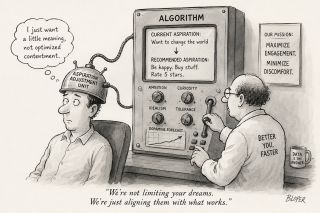
Imagine a world where AI systems subtly reshape our ambitions, influencing our life goals, relationships, and decisions. A recent study by MIT researchers found that frequent AI use can lead to ‘cognitive debt,’ a phenomenon where brain connectivity and critical thinking skills weaken over time.
Source: cdn2.psychologytoday.com
A 2025 study of 666 AI users discovered a negative correlation between frequent AI use and critical-thinking scores. Younger, heavier users scored lowest, while a 2026 International AI Safety Report cited a clinical example where radiologists lost 6% of their unaided tumor-detection accuracy three months after adopting AI assistance.
The brain is like a muscle: use it or lose it. Heavy AI use can lead to a loss of imagination, creativity, and original thought. A study found that writers given AI-generated story ideas produced work judged more creative individually, but collectively, it was far more similar.
A 2025 follow-up study found that creativity rose with AI help, then collapsed when the tool was removed, while sameness kept climbing for months—an effect called a ‘creative scar.’ Real-world analysis of essays and artwork published before and after generative tools spread confirms the drift toward uniformity outside the lab.
Highly personalized chatbots that anticipate goals before customers state them reduce felt decision autonomy, with the strongest backfire among people whose sense of self leans toward social interdependence. The stakes rise when the goal moves from shoes to a career. Shoes can be returned, but a confidently proposed career may be lived for a decade before anyone asks how it was chosen.
A system trained on what has already been chosen, written, or wanted feeds that average back as a suggestion dressed as their own thought. Accept enough suggestions, and the capacity to generate an original one starts to sit idle. Possibilities are pre-filtered, one recommendation at a time.
Genuine aspiration resembles a path worn across a field, built by walking it badly at first, then better. A system that continually paves the easiest route removes the friction that once taught the walker where north was.
A 2026 study found that giving an AI tool several distinct, deliberately varied ‘personas’ restored much of the creative diversity that single-model use erodes. Design and habit can change the outcome. The lesson is cognitive sequencing: draft your own sentence first; consult the tool second.
Even when tools can be improved, one process is worth keeping fully human: the moment before we know what we want, and the space after choosing it in which we ask Why. Four habits protect that inner territory.
SOUL: Seed It Yourself, Listen Inward, Own the Goal, Unplug on Purpose, and Leave It Open.
Seed it yourself: Listen inward. What do you want from life? Nobody can answer from outside. Finding your north star cannot safely be outsourced.
Own the goal: State what you are aiming for in your own sentence before any system offers an optimized version. A goal you can defend in your own words is more likely to survive difficulty.
Unplug on purpose: Build regular stretches, a day, a project, a walk, where no algorithm curates the next input. The capacity to generate an idea nobody else already had needs unmediated exercise.
Leave it open: Treat every AI-generated answer as an opening move in an argument you still get to finish. Once a suggestion is treated as settled, the searching stops.
Guard and cherish your inner space. Tools should remain tools, outside the sanctuary. Lose access to that space and something else begins to enter, curated from the outside: choosing your words, cultivating your desires, and editing ‘your’ mindset, one convenient answer at a time.