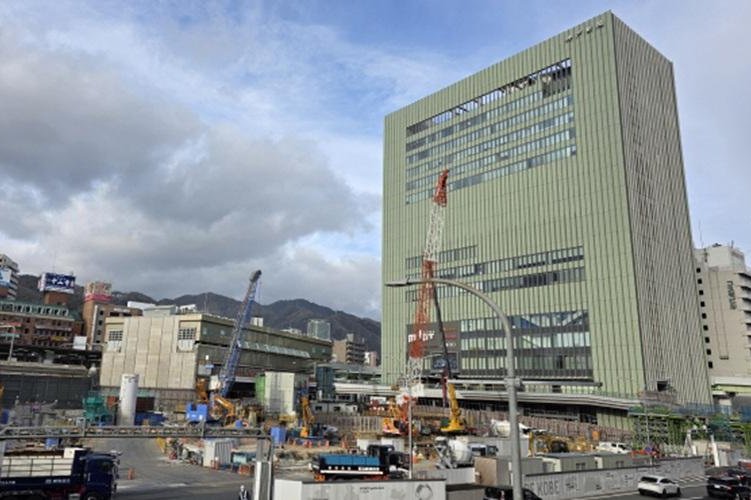
Japan’s Railway Station Redevelopment Projects Face Financial Challenges
Major railway station redevelopment projects in regional Japanese cities are being suspended or reconsidered due to rising construction costs, higher interest rates, and labor shortages, which are undermining their financial viability.
The setbacks suggest that the long-standing strategy of using large station-area developments to attract residents and businesses is facing new limits in an era of population decline.
According to The Yomiuri Shimbun, Nagoya Railroad has effectively abandoned its original redevelopment plan near Nagoya Station, while JR Kyushu has halted a project at Hakata Station in Fukuoka because of rising construction expenses.
Nagoya Railroad, commonly known as Meitetsu, announced in March 2025 that it would demolish six buildings near the station, including the Meitetsu Department Store and a bus terminal.
The company planned to construct two high-rise buildings containing offices, stores, and a hotel. The project also would have expanded the underground railway from two tracks to four and enlarged its platforms and passenger areas.
The total project cost was estimated at 888 billion yen ($5.46 billion).
The development was expected to become a central part of Nagoya’s urban transformation ahead of the opening of the Chuo Shinkansen magnetic-levitation line.
Meitetsu suspended the construction schedule in December and began reconsidering the entire plan after a prospective contractor withdrew from the bidding process because it could not secure enough workers.
Meitetsu President Hiroki Takasaki said in May that the company would review the project with the aim of reducing construction complexity and risk while scaling back its investment.
The work would require advanced construction techniques because railway facilities, a bus terminal, and commercial buildings overlap at the site.
Much of the construction also would have to be conducted at night to avoid disrupting train operations.
Rising material and labor costs, higher borrowing expenses, and shortages of skilled construction workers further weakened the project’s expected profitability.
Similarly, JR Kyushu suspended its Hakata Station Sky City project in September 2025.
The company had planned to build offices and a hotel above the railway tracks at Hakata Station.
Construction costs, initially estimated at about 43.5 billion yen ($267.7 million), nearly doubled, leading the company to conclude that the project could not generate an adequate return.
Nagoya and Hakata stations are major transportation and commercial centers in two of Japan’s largest regional cities.
Both locations already have substantial passenger traffic and established commercial districts. Their projects nevertheless became financially difficult because of complex construction requirements and rising costs.
The setbacks are challenging the conventional assumption that building large towers around a railway station will automatically draw more people and revitalize the surrounding economy.
Rising costs also are affecting national projects in Japan.
JR Central increased the estimated construction cost of the Chuo Shinkansen maglev project from about 7 trillion yen to 11 trillion yen ($43.08 to $67.69 billion) in October 2025.
Organizers of the 2026 Asian Games in Aichi and Nagoya also abandoned plans to construct a dedicated athletes’ village because of concerns about rising expenses.
Japan’s experience offers lessons for South Korea, where regional governments are promoting developments around high-speed railway stations and integrated transportation centers as a response to population decline outside the Seoul metropolitan area.
The Japanese cases suggest that constructing a railway station and large commercial buildings before securing sustainable demand may not be enough to attract residents and companies.
The viability of such projects increasingly depends on realistic assessments of population trends, commercial demand, financing costs, construction capacity, and the long-term use of the completed facilities.
The Japanese government should reconsider its approach to large-scale development projects and prioritize a more sustainable and demand-driven strategy.