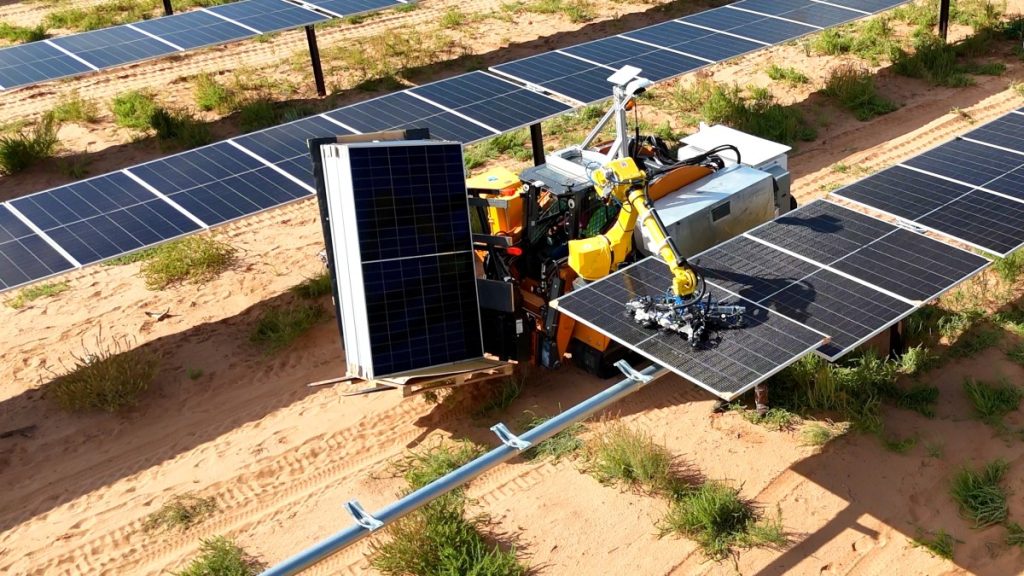
Gritt Aims to Revolutionize Solar Plant Construction with AI-Powered Robots
As the world transitions towards renewable energy sources, the construction of solar plants has become a crucial aspect of achieving energy independence and mitigating the effects of climate change. However, the rapid growth of the solar industry has led to a labor market challenge, with a limited supply of workers to meet the increasing demand for installation.
Enter Gritt, a startup founded by two Carnegie Mellon-trained roboticists, CEO Puneet Puri and CTO Vishal Dugar. The company has emerged from stealth mode with a $26 million Series A round of funding led by Obvious Ventures, with participation from Union Square Ventures and Active Impact Investment. This funding brings Gritt’s total investment to $34 million, following an earlier seed round backed by First Round Capital, Climactic, Congruent Ventures, and VSC Ventures.
Gritt’s Vision: AI-Powered Robots for Solar Plant Construction
Gritt’s mission is to develop an intelligent system that can help construct infrastructure faster and more efficiently. The company’s thesis is that a generalizable AI model can work in unstructured environments, such as construction sites, and adapt to varied environments.
The startup is not building its own robots from scratch but instead uses off-the-shelf hardware, such as rented skidders and robotic arms, to create platforms controlled by its AI models. The first task its systems handle is unloading large glass solar panels, carrying them towards the metal frames where they need to be installed, and positioning them on the frames with sub-millimeter accuracy.
Gritt has two systems currently deployed in the field, collecting data to improve their behavior. The company claims that a typical eight-person crew can install 800 panels a day, but with Gritt’s systems, the same crew can install 3,000 to 4,000 panels each day.
The company has secured contracts to help install 2.8 gigawatts of solar panels in the next 18 months and has three of the top 10 US power construction companies as customers. Gritt aims to operate 48 of its systems within the next six months.
Competition in the AI-Powered Robot Market
Gritt is not alone in the AI-powered robot market. Companies like Luminous Robotics, Cosmic, and China’s Trinabot are also developing robots to install solar panels. However, Gritt’s focus on using off-the-shelf hardware and AI models sets it apart from its competitors.
Future Plans: Expanding Manipulation Tasks and Construction Sites
Gritt plans to add new manipulation tasks to its system, such as fastening solar panels, drilling posts, and building racks. The company also aims to move into other common labor-intensive construction tasks, like tying rebar before concrete is poured over it.
The Rise of New AI Models: Enabling Gritt’s Vision
The founders of Gritt attribute the company’s success to the rise of new AI models. These models have made it possible for Gritt to create a generalizable AI system that can adapt to various environments and tasks.
Training New Tasks and Boosting Management and Decision-Making
Gritt’s vision goes beyond just installing solar panels. The company believes that its system can boost management and decision-making on construction sites. For instance, its system can alert workers to cover trenches before rain damages components or flag missing inventory.
Gritt’s Impact on the Solar Industry
Gritt’s AI-powered robots have the potential to revolutionize the solar industry by increasing efficiency and reducing labor costs. As the company continues to grow and expand its capabilities, it is likely to have a significant impact on the construction of solar plants and the broader renewable energy sector.
Bullet points:
- Gritt has emerged from stealth mode with a $26 million Series A round of funding.
- The company’s total investment now stands at $34 million.
- Gritt’s AI-powered robots can install 3,000 to 4,000 solar panels per day.
- The company has secured contracts to help install 2.8 gigawatts of solar panels in the next 18 months.
- Gritt aims to operate 48 of its systems within the next six months.