Uncovering a Fossilized Giant
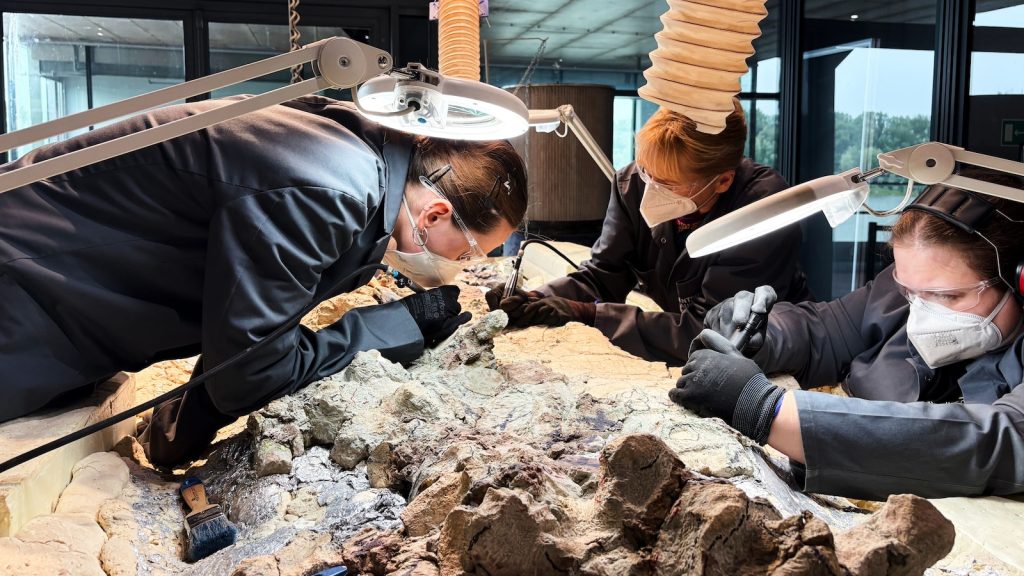
Located within the glass-walled laboratory of Warsaw’s Copernicus Science Centre lies a fascinating project – the restoration of a massive prehistoric skeleton, Mastodonsaurus, with the help of over 2,000 volunteers. This remarkable endeavor is not only an opportunity for the public to engage with science but also provides a unique perspective on the natural world.
Volunteers, ranging from managers to tattoo artists, armed with chisels, brushes, and protective goggles, meticulously chip away at the rock encasing the bones of this ancient amphibian. The work is painstaking, requiring millimeter-by-millimeter separation of bone from surrounding rock using a pneumatic chisel. The process is guided by ultraviolet light, which reveals where the bone ends and the surrounding rock begins.
‘I imagine that those bones were lying underground for 240 million years and I am the first human on earth to touch them,’ said Tatyana Kozyk, the coordinator of the volunteer teams. ‘I’m still trying to wrap my head around this experience.’
The Mastodonsaurus, an underwater ambush hunter, lived approximately 240 million years ago during the Middle Triassic, a time when the earliest dinosaurs were emerging. This fearsome aquatic predator, measuring nearly six meters in length, had a broad, flat head, long jaws, and sharp conical teeth, resembling a crocodile’s appearance but belonging to a different branch of the vertebrate family tree.
When the restoration is complete, the Mastodonsaurus skeleton will be the largest exhibited in a museum anywhere in the world, weighing 1,300 kilograms. According to Tomasz Sulej, a paleontologist and professor at the Institute of Paleobiology at the Polish Academy of Sciences, ‘The structure of the body is different from what we knew so far. This is information that is completely new to the scientific world.’
Other Mastodonsaurus skeletons have been discovered in Germany and Russia, but they are significantly smaller, ranging from 2 to 3 meters in length. The discovery of this massive skeleton in southern Poland in 2023 has provided scientists with a unique opportunity to learn more about the species.
As the volunteers work on the skeleton, they are not only contributing to the scientific community but also gaining a deeper appreciation for the natural world. ‘Working with the skeleton of an ancient animal is an experience that is at the same time ‘relaxing and philosophical, even mystical,’ said Dorota Serafin, a 51-year-old manager from Warsaw who volunteers for the project.
The story of the Mastodonsaurus offers a glimmer of hope in the face of climate change and the potentially catastrophic effects it may have on our planet. As Sulej notes, ‘The Mastodonsaurus lived after the great extinction, which shows one thing, that nature always manages. It’s not true that humans can destroy life on this planet. Nature and life always find ways to survive.’