
Browser Fingerprinting: The Silent Threat to Your Online Anonymity
Uninterrupted browsing used to be a lot simpler. You could disable third-party cookies, blacklist known tracking domains, and get an ad blocker to ensure your online safety. However, the game has changed. Online platforms can now pick up on your screen resolution, basic hardware specs, time zone, and installed fonts to establish a unique fingerprint for your browser and device.
Source: lifehacker.com
Websites can query a lot of seemingly harmless data from your device without prompting any security reaction, which, over time, they can use to trace your browsing activity. This is a major concern for anyone who truly cares about their online privacy.
Source: lifehacker.com
Luckily, browsers like Safari, Firefox, Brave, and others have evolved to address this problem using more privacy features that cost nothing to enable. In this article, we will take a look at how these browsers handle fingerprinting and provide step-by-step instructions on what you need to configure or enable manually to minimize your digital footprint.
Source: lifehacker.com
What is Browser Fingerprinting?
Browser fingerprinting is an advanced tracking method where a website queries minute technical details about your device, anything from your operating system to the drivers used by your GPU, to create a unique digital identification for your browser. It then uses this ID to record your on-site sessions and trace your browsing activity across the web, completely bypassing the need for cookies.
Unlike cookies, fingerprinting does not require a website to install files or extensions to your web browser. Instead, it uses server-side and JavaScript-executed signals to collect innocuous details about your device and setup, such as:
- Canvas fingerprinting: A simple JavaScript command forces your browser to draw a hidden 2D image, which is then hashed to uncover specific details about your graphics card, operating system, hardware drivers, and so on.
- WebGL rendering: Instead of rendering drawings on a 2D canvas, this forces the browser to render a 3D image in WebGL, revealing even more details about your graphics processor make and model.
- Font enumeration: By rendering specific text strings and measuring bounding box layouts, APIs map out the entire font library installed on your system.
- AUDIOContext cues: This processes a silent audio signal through your sound hardware, creating a soundwave signature that’s unique to your device.
- Hardware details: Device hardware specifications are considered low-hanging fruit that most fingerprinting APIs can pull easily. Things like screen resolution, storage space, battery levels, processor cores, etc. can be cobbled together to craft a unique digital ID.
Checking Your Browser Fingerprint
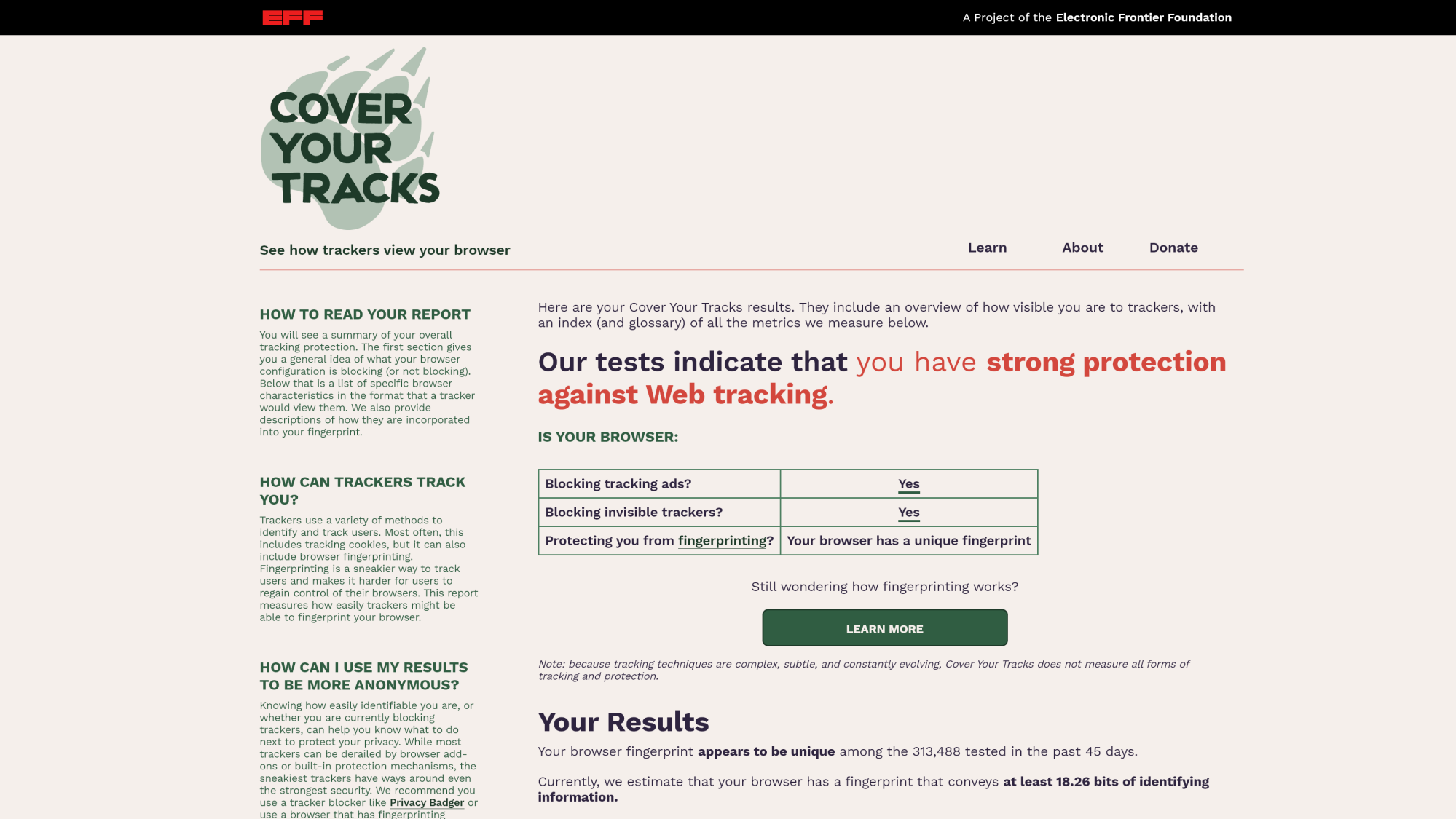
If you’re curious about what kind of data your browser might be leaking to websites, Cover Your Tracks lets you run free scans that show you exactly how exposed you are. You can also rerun this check as many times as you want after adjusting your privacy settings.
The site generates an immediate report that tells you whether you have cookies or trackers enabled in your browser, along with the types of data your device is leaking that can be accessed by fingerprinting technology. For example, scanning my Chromium-based Arc Browser revealed that I was leaking 18.26 bits of identifying information, including my time zone, language preferences, font library, and privacy settings in the HTTP headers when accessing a site, as well as a unique fingerprint tied to my device through Canvas and WebGL rendering.
How to Prevent Browser Fingerprinting on Chrome, Edge, Firefox, Safari, and Others
You can’t fully stop browser fingerprinting because the technology does not rely on a single point of access to collect your data. But that doesn’t mean you can’t make it harder for sites and trackers to get to you. Let’s take a look at how each browser handles fingerprinting and what you need to configure or enable manually:
Apple’s Advanced Tracking and Fingerprinting Protection in Safari
Apple introduced Advanced Tracking and Fingerprinting Protection in Safari at the same time as the release of iOS 17 and macOS Sonoma. The company has also heavily expanded the feature since its original release. As long as you’re on Safari 17+, you can enable this opt-in feature for added privacy when browsing the web:
On iPhone and iPad:
- Navigate to Settings > Apps > Safari > Advanced.
- Tap Advanced Tracking and Fingerprinting Protection.
- Select All Browsing.
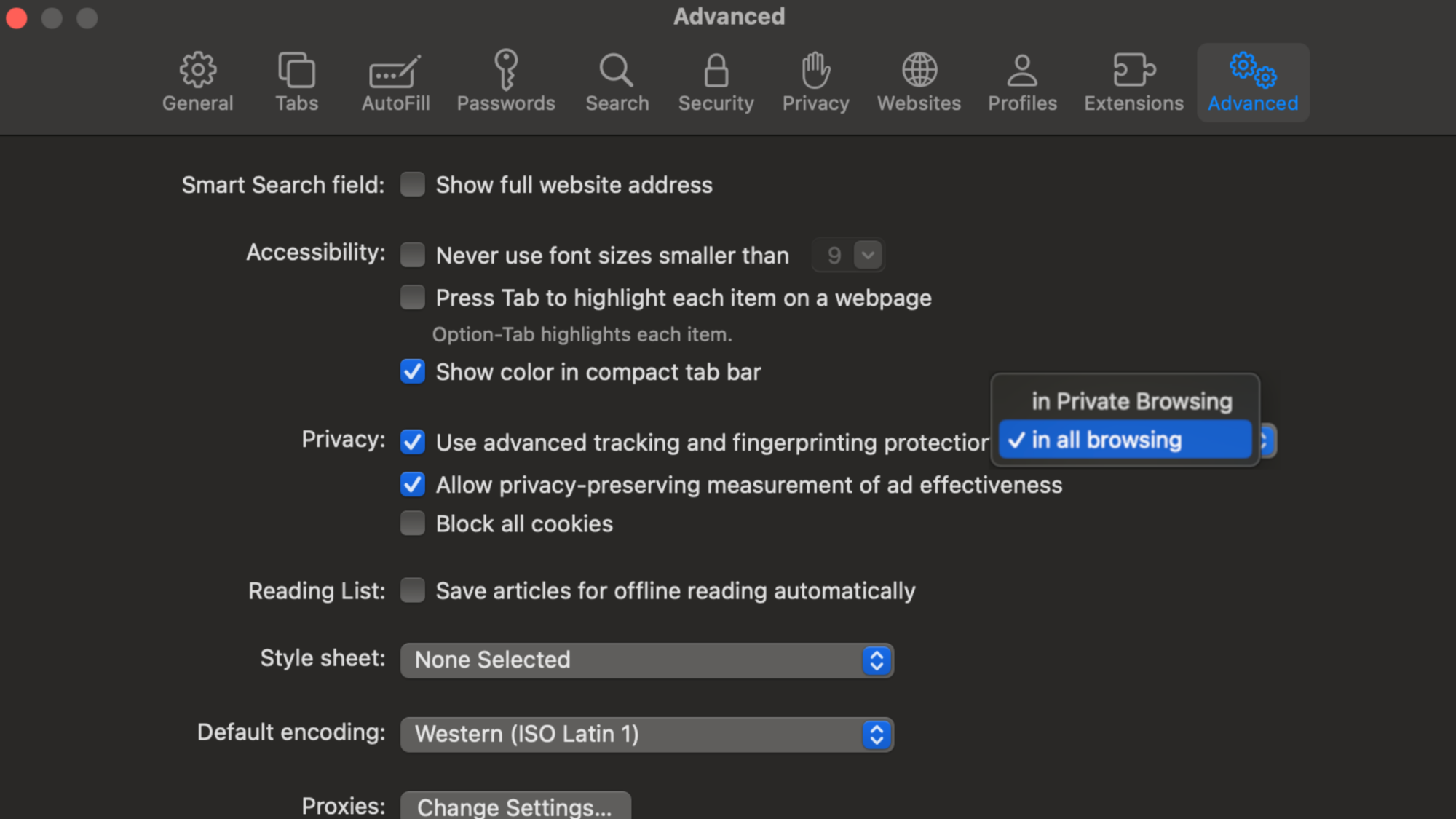
Launch Safari. Then navigate to Safari > Settings from the menu bar.
- Click the Advanced tab.
- Make sure to enable Use advanced tracking and fingerprinting protection and choose All browsing from the drop-down menu.
Microsoft Edge’s Fingerprinting Protection
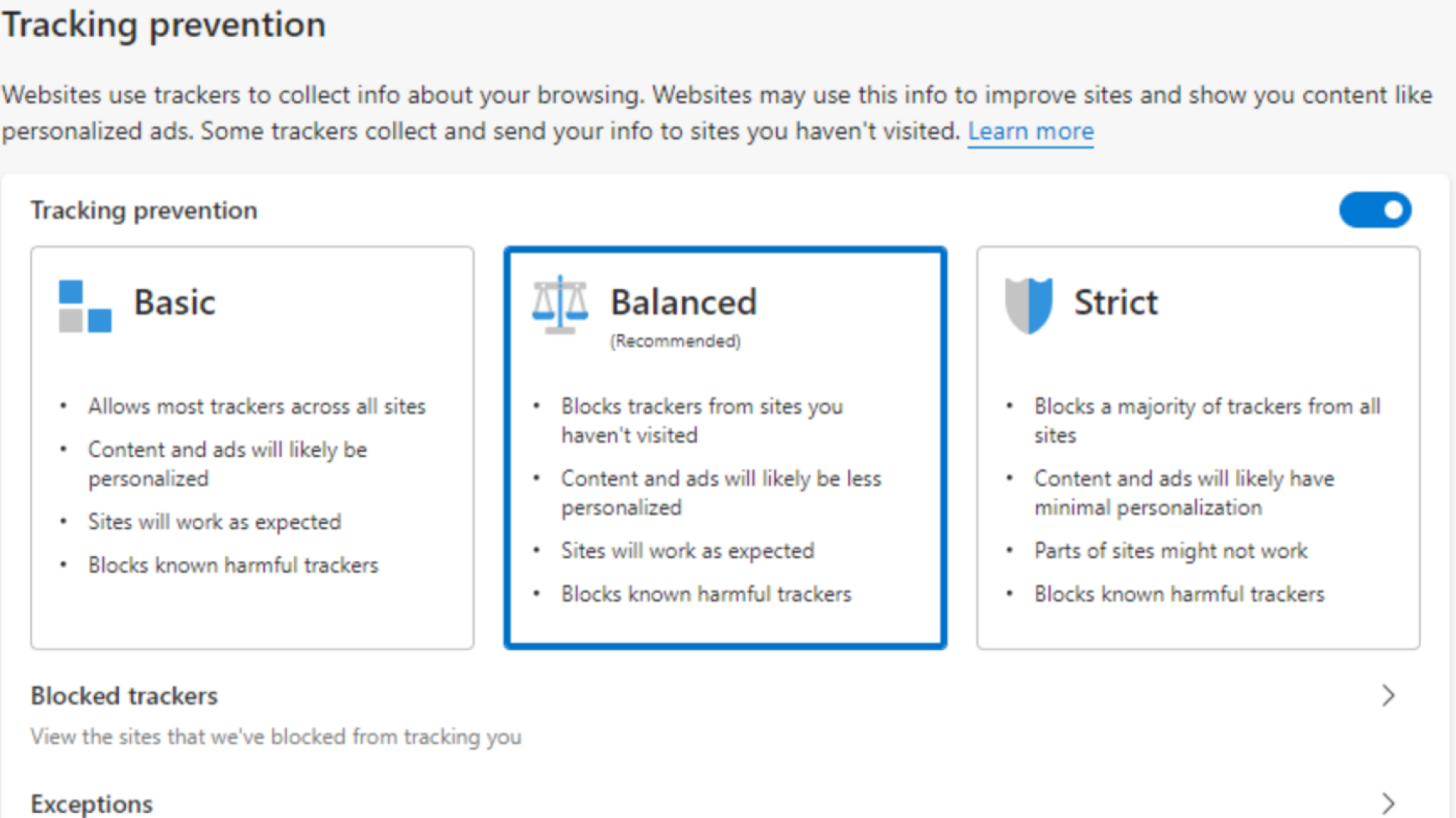
Microsoft Edge offers fingerprinting protection even at the lowest privacy settings, without requiring any action on your part. However, you can enhance the level of protection by following these steps:
Launch Edge on your Windows computer, click on the three dots in the upper right corner, and navigate to Settings > Privacy, search, and services.
- Look for the section that reads Tracking prevention and opt for the Strict option for the maximum level of security from fingerprinting and cryptomining.
- You can also scroll down to Exceptions to whitelist trusted websites that need tracking enabled to work properly.
Firefox’s Enhanced Tracking Protection
Firefox bundles all its privacy features under Enhanced Tracking Protection, which covers both fingerprinting and cookies. There’s even a privacy.resistFingerprinting flag available for advanced users in the hidden config page, but that’s overkill for most regular users and can disrupt basic functionality on many modern websites.
For most internet users, enabling the following features should be sufficient protection against most fingerprinting APIs:
In Firefox, go to Settings > Privacy & Security.
- Under Enhanced Tracking Protection, select Custom.
- Make sure the boxes next to Cookies and Fingerprinters are both checked. Fingerprinter blocking should also be set to All windows to extend protection beyond incognito browsing.
Brave’s Shields Component
Though it’s Chromium-based, Brave’s developers have gone out of their way to implement strong fingerprinting protection into the browser using the Shields component. This is one of the strongest out-of-the-box fingerprinting prevention settings that I have tested, and it’s very easy to enable:
Click the lion icon in the address bar of your Brave browser window to access Brave Shields. You can also do this by navigating to Settings > Shields.
Make sure that Trackers & ads blocking is set to Standard or higher.
Fingerprint protection is now enabled. Brave Shields works by effectively scrambling any data collected by fingerprinting APIs, so trackers cannot obtain any consistent information to establish a profile for your browser.
Chrome’s Lack of Built-in Fingerprinting Protection
Now for the elephant in the room: since Google shuttered its Privacy Sandbox component in April 2025, Chrome does not offer built-in fingerprinting protection. However, there are several third-party extensions you can use to add these features to your browser, with caveats:
Canvas Blocker: When a website uses the HTML canvas element to create a unique fingerprint for your device, Canvas Blocker adds some random noise to the data generated by the canvas element to confuse fingerprinting APIs.
Fingerprint Spoofer: A much more complete anti-fingerprinting extension, since this also blocks JavaScript and image-based fingerprinting and can spoof user agent or navigator values.