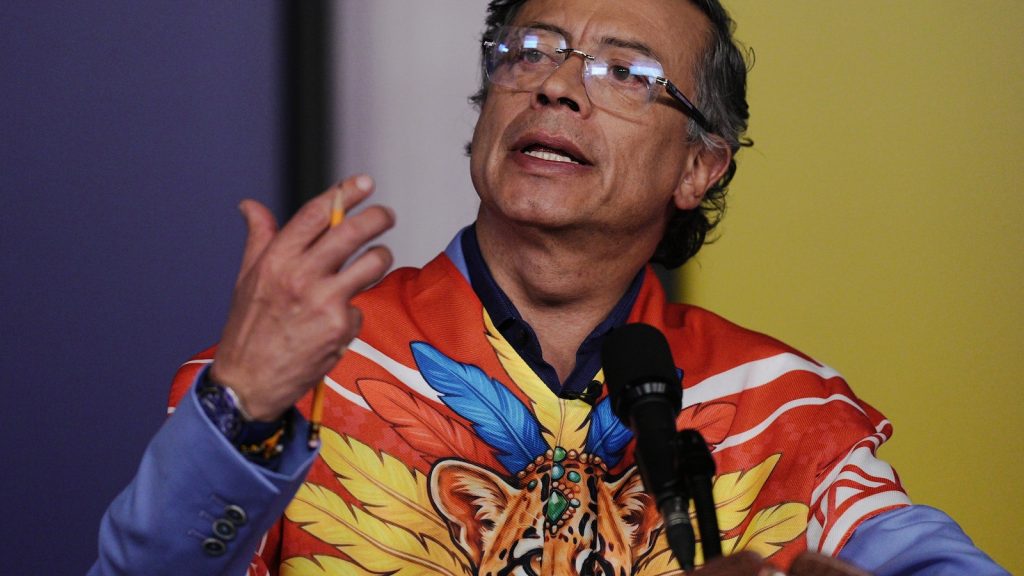
Colombian President Gustavo Petro Continues to Deny Election Loss
Colombia’s outgoing President Gustavo Petro has reiterated claims of fraud in the nation’s June election, which his party lost narrowly to conservative leader Abelardo de la Espriella.
In an hour-long presentation to journalists, Petro claimed that results from thousands of tally sheets were manipulated by programmers after vote counts were transmitted to the headquarters of Colombia’s national registrar, the agency in charge of organizing the elections.
The accusations of fraud have been dismissed by international observers as well as electoral authorities in Colombia, which declared in late June that conservative lawyer Abelardo de la Espriella won the election, defeating Petro ally Ivan Cepeda by 250,000 votes.
De la Espriella will begin a four-year term on Friday after he is sworn into office in a joint session of Congress. Petro, a longtime critic of Colombia’s political establishment, has refused to acknowledge the results of the June presidential election.
On Monday, the outgoing president accused electoral authorities of running an ‘obscure’ election manipulated by foreign powers, and said that officials did not provide metadata for tally sheets that were scanned and posted on a public website, where citizens can check the results of every voting center in the country.
‘We are facing a profound institutional problem,’ Petro said. ‘And it’s the inauguration of an illegitimate president.’
Under Colombian law, there is little Petro can do to stop de la Espriella from being sworn into office this week because the conservative leader’s victory has already been certified by electoral judges.
However, analysts say that Petro’s claims of electoral fraud could undermine de la Espriella’s legitimacy among some voters and further polarize the nation’s politics.
Cepeda has said he will organize a series of protests against the incoming president, and will not acknowledge him as Colombia’s leader until de la Espriella meets several conditions that include renouncing his dual U.S. citizenship.
Petro, a former member of a rebel group, earlier Monday also urged people in rural areas to form committees he described as ‘liberation guards’ that could resist the actions of military detachments that, according to him, are allied with local mafia groups.
Andres Macias, a political-science professor at Colombia’s Externado University, said that Petro’s statements could help ‘justify the use of weapons by civilians’ in areas that have already been affected by conflicts between the Colombian military, drug traffickers, and rebel groups.
Petro said Monday he feared being ‘extracted’ from Colombia after he steps down from office to become an opposition leader and continues to make claims that Colombia’s election was rigged.
‘I’ve been told to behave well,’ Petro said. ‘But as a democrat I cannot accept this electoral fraud.’
International Observers Dismiss Fraud Claims
International observers and electoral authorities in Colombia have dismissed Petro’s claims of electoral fraud, stating that the election was conducted fairly and transparently.
The Organization of American States (OAS) and the European Union (EU) both sent observers to monitor the election, and their reports concluded that the vote was free and fair.
Colombian electoral authorities have also stated that the election was conducted in accordance with the country’s laws and regulations, and that the results were accurately counted and reported.
Petro’s refusal to acknowledge the results of the election has raised concerns about the stability of the country’s democratic institutions and the potential for further polarization and conflict.
Consequences of Petro’s Actions
Petro’s actions have the potential to undermine the legitimacy of the incoming government and create further instability in the country.
His claims of electoral fraud could also embolden extremist groups and encourage violence and protests against the government.
Analysts say that Petro’s actions are a threat to the country’s democratic institutions and could have long-term consequences for the stability and prosperity of Colombia.
The country’s international partners and allies are closely watching the situation and are likely to be concerned about the potential implications for regional stability and security.
Conclusion
In conclusion, the situation in Colombia is complex and multifaceted, with far-reaching implications for the country’s democracy, stability, and international relations.
Petro’s refusal to acknowledge the results of the election and his claims of electoral fraud have raised concerns about the potential for further polarization and conflict.
The international community is closely watching the situation, and it remains to be seen how the situation will unfold in the coming weeks and months.