Korean Shipbuilders Target Saudi Naval Projects
South Korea’s two leading naval shipbuilders, HD Hyundai Heavy Industries and Hanwha Ocean, are poised to capitalize on a major naval modernization program in Saudi Arabia, estimated to be worth around 8 trillion won ($5.4 billion).
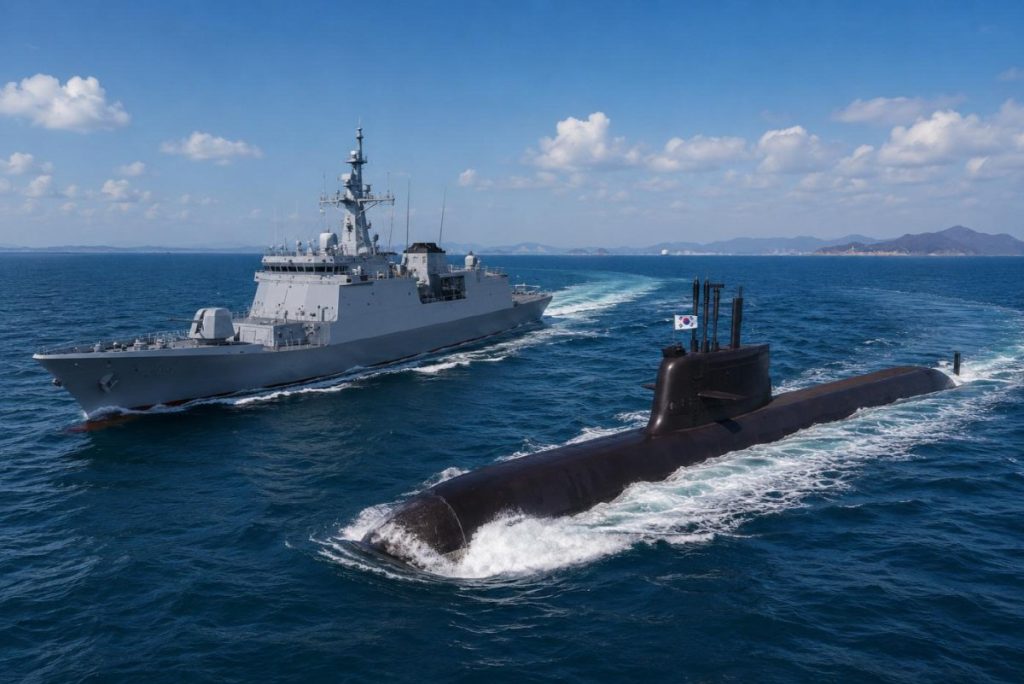
According to industry officials, the two companies are expected to pursue separate surface ship and submarine opportunities, with HD Hyundai Heavy Industries focusing on a proposed frigate program and Hanwha Ocean concentrating on potential submarine orders.
This arrangement could allow the companies to avoid competing against each other and instead direct their resources towards European defense contractors seeking the same Saudi contracts.
The potential division of roles follows an agreement promoted by South Korea’s Defense Acquisition Program Administration to strengthen cooperation among domestic companies pursuing overseas warship contracts.
Under the industry arrangement, HD Hyundai Heavy Industries would primarily pursue surface combatant opportunities, while Hanwha Ocean would emphasize submarines, with the goal of reducing costly competition between South Korean companies and improving their ability to compete against foreign shipbuilders.
HD Hyundai Heavy Industries has already displayed its HDF-6000 export frigate at the World Defense Show in Riyadh in February, which was designed specifically to address requirements in the Saudi defense market.
Hanwha Ocean, on the other hand, has indicated that it does not plan to participate in the Saudi surface ship program, increasing the likelihood that the two companies will pursue different parts of the modernization effort.
The Korean companies would face strong competition from established European naval contractors, including Germany’s Thyssenkrupp Marine Systems, which is considered a potential competitor in the submarine sector.
French and Spanish shipbuilders could also compete for Saudi surface ship and submarine orders as Riyadh continues modernizing its naval forces.
Localization could play a crucial role in determining the winner, with local production, technology transfers, supply chain development, and workforce training likely to be key factors in the competition.
Saudi Arabia’s Vision 2030 development program calls for more than 50% of government spending on military equipment and services to be localized by 2030.
Foreign companies seeking Saudi defense contracts are therefore expected to demonstrate how they would manufacture, maintain, and support equipment inside the kingdom.
HD Hyundai Heavy Industries is expanding cooperation with Makeen, a Saudi-based marine engine joint venture, which has been established through investment by HD Korea Shipbuilding & Offshore Engineering, Saudi Aramco Development Co., and other partners.
The company is expected to use the partnership to propose localized engine production and a Saudi supply network for its frigate offering.
Hanwha Ocean, on the other hand, is developing submarine products and services tailored to requirements in Saudi Arabia and the broader Middle East.
The company has signed an agreement with Kolon Spaceworks to cooperate in pursuing submarine business in Saudi Arabia and other Middle Eastern markets.
Hanwha Ocean has also formed partnerships with other South Korean suppliers to strengthen its submarine technology and establish a supply network capable of supporting overseas production and maintenance.
Industry officials believe that the division of responsibilities could improve South Korea’s chances of winning Saudi contracts.