Meta’s AI Chip Revolution: A Game-Changer in the Making
Meta, the tech giant behind social media platforms like Facebook and Instagram, is on the cusp of a major breakthrough in the world of artificial intelligence (AI). In a bid to reduce its reliance on Graphics Processing Units (GPUs) from companies like Nvidia and AMD, Meta is set to start producing its latest AI-specific chips in September. According to a report by Reuters, citing an internal memo, at least one of these chips has successfully completed its testing phase in a remarkably short six weeks.
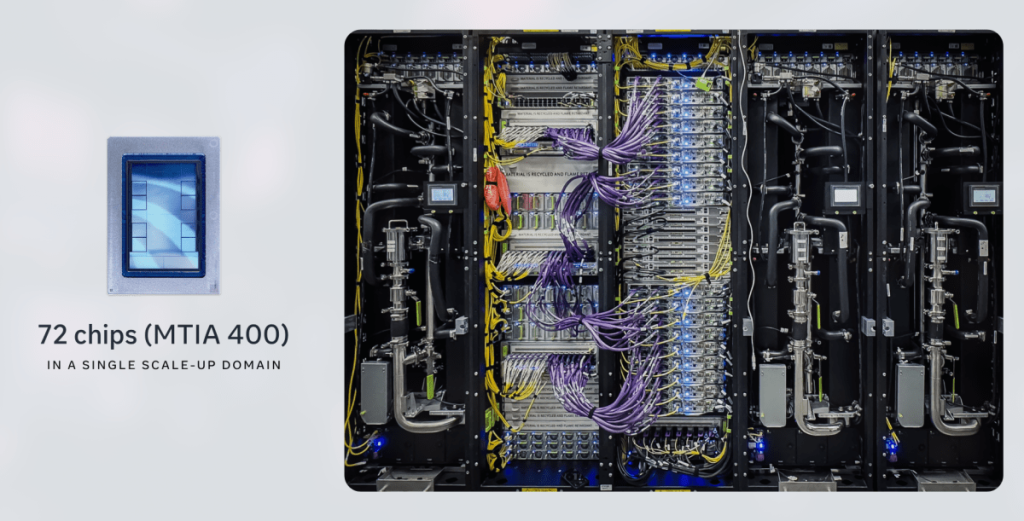
Meta’s AI-specific chip is being developed under the Meta Training and Inference Accelerator (MTIA) program. The company has been working with Broadcom on the chip design, while Taiwan Semiconductor Manufacturing Company (TSMC) will be responsible for manufacturing the chips. In addition, Meta will be sourcing RAM from Samsung, storage from Sandisk, and fiber-optic equipment from Sumitomo Electric.
The MTIA program aims to create a modular approach to designing these chips, anticipating the rapid evolution of AI. This approach involves using modular chiplets, incorporating the latest AI workload insights and hardware technologies, and deploying on a shorter cadence. As the company explained in March, ‘Each MTIA generation builds on the last, using modular chiplets, incorporating the latest AI workload insights and hardware technologies, and deploying on a shorter cadence.’
The AI chips are expected to help Meta save on buying GPUs from companies like Nvidia and AMD. However, the company still plans to spend significant amounts with these providers. The chips will be used for training models for Meta’s ranking and recommendation algorithms, broader AI workloads, and inference aimed at its applications. This move marks a significant step forward in Meta’s efforts to produce its own AI chips, a journey that began in 2023.
Meta has been investing heavily in securing enough compute capacity to power its various AI efforts. The company has been spending tens of billions of dollars on data centers and power deals across the world. In April, Meta announced that it expects capital expenditures between $125 billion and $145 billion this year, a significant portion of which is going toward its AI efforts. The company plans to deploy 7 gigawatts of compute this year and double that next, according to Reuters.
Meta’s efforts to stem the tide of capital going to Nvidia are not unique. Other companies, such as OpenAI and Anthropic, are also exploring the development of their own AI chips. Amazon and Google have been developing their own chips for AI training and inference, and a host of startups are working in the space to meet the skyrocketing demand.
In a bid to reduce its reliance on GPUs, Meta is taking a bold step into the world of AI chip production. The company’s AI chips are expected to be used for training models for its ranking and recommendation algorithms, broader AI workloads, and inference aimed at its applications. As the AI landscape continues to evolve, Meta’s move is likely to have significant implications for the industry.